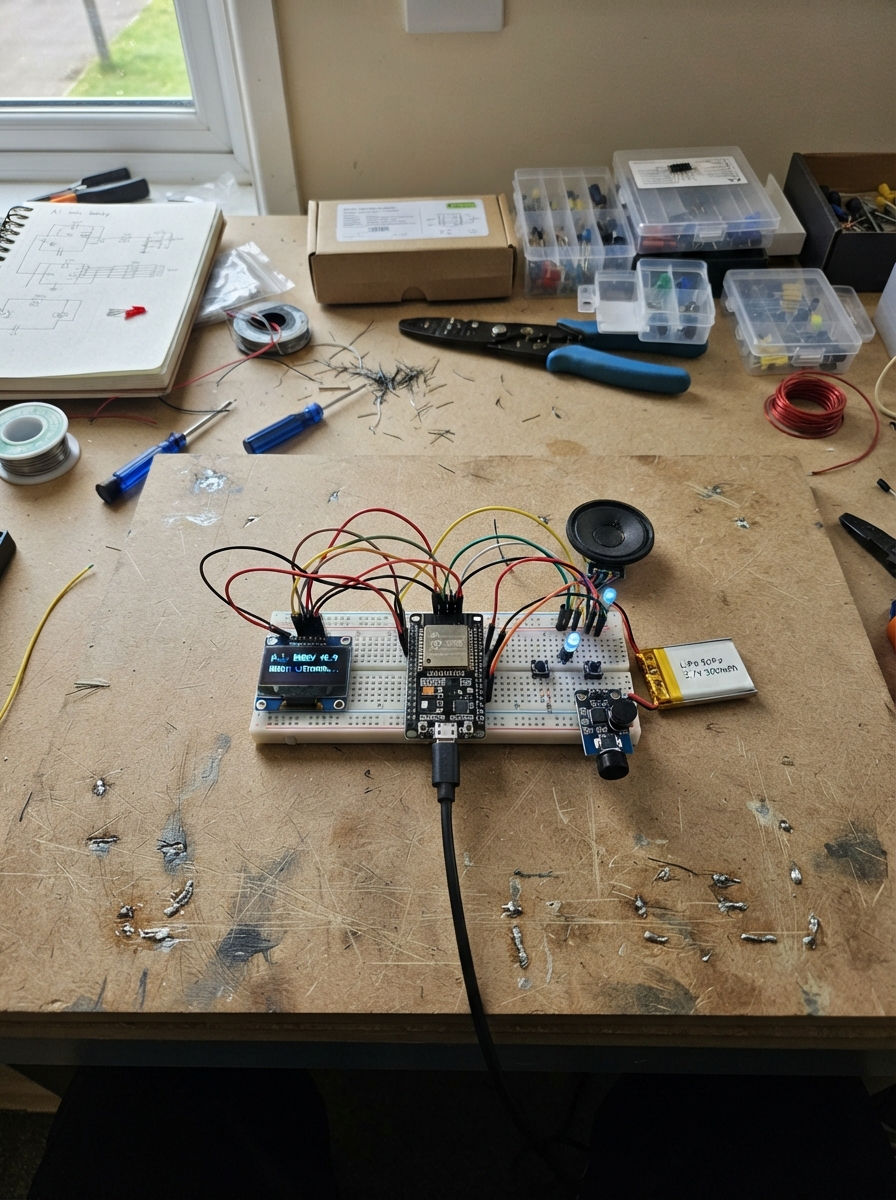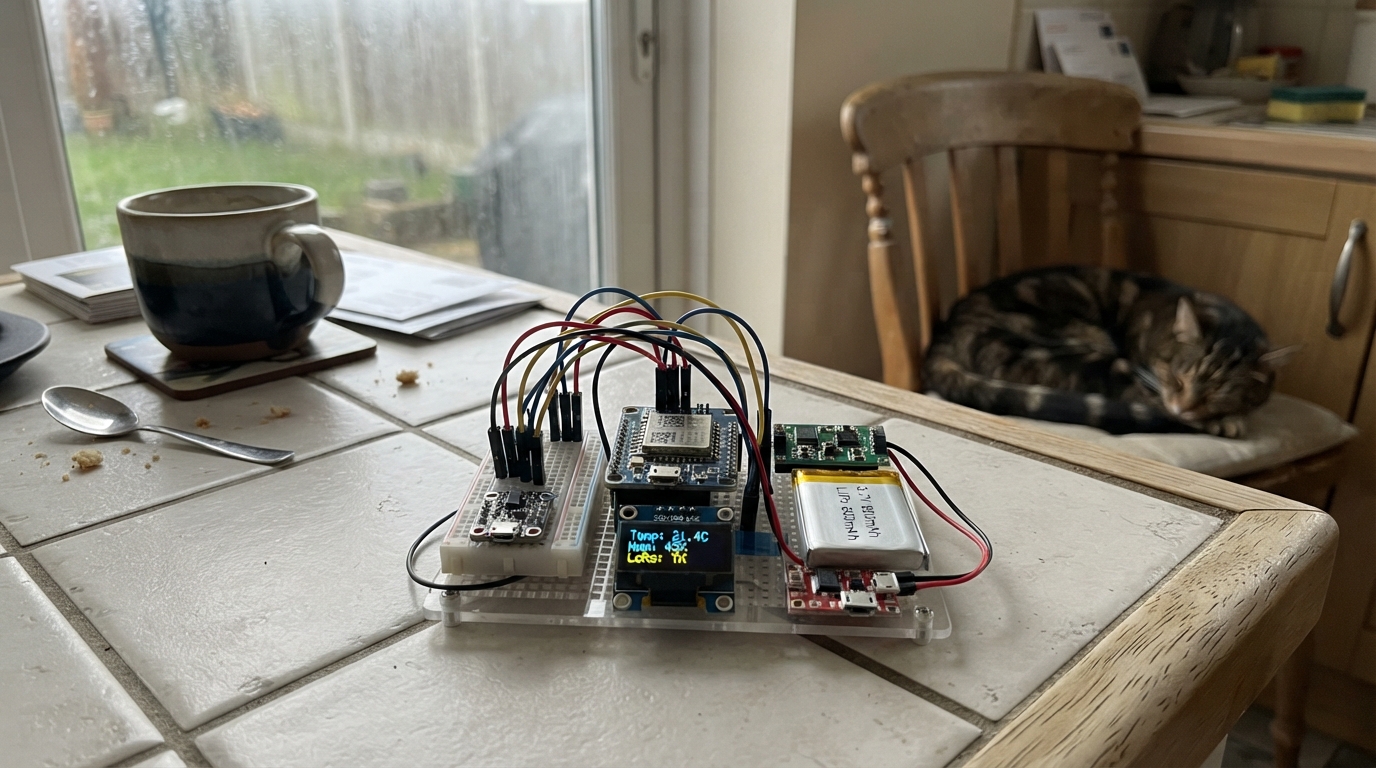
This tethered atmospheric monitoring station uses an ESP32 with a BME280 sensor to measure temperature, humidity, and pressure from a payload suspended on a tether. Data transmits wirelessly via LoRa to a ground station equipped with an SSD1306 display, allowing real-time observation of atmospheric conditions at altitude. The system runs on a rechargeable LiPo battery with integrated charging and power management.
This guide provides a complete wiring diagram, parts list, and step-by-step assembly instructions for building both the airborne payload and ground station receiver. Firmware is included to handle sensor readings, LoRa communication, display output, and battery monitoring. Builders will learn how to integrate I2C sensors, configure LoRa modules, and deploy a wireless telemetry system suitable for meteorological experiments and environmental monitoring.
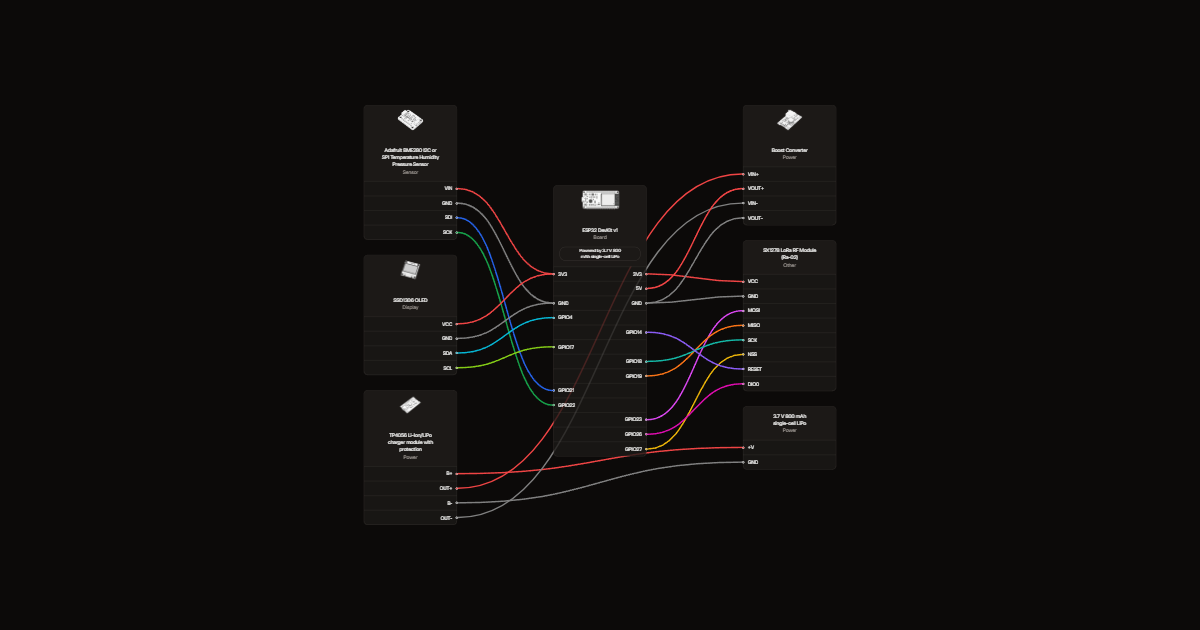
Wiring diagram
Gather all the parts
Assemble it in 4 steps
1. Wire the payload
On the first ESP32 DevKit V1, connect the BME280 and one Ra-02 radio as shown. Leave GPIO33 unconnected. Do not connect the OLED here.
2. Wire the ground display
On a second ESP32 DevKit V1, repeat the radio wiring with a second Ra-02. Connect the OLED as shown and add a GPIO33 to GND jumper to select receiver mode. Do not connect a BME280 here.
3. Deploy and test on the bench
Plug each board in by USB and deploy the same firmware to each. With the payload sitting still at startup, check that the OLED shows temperature, humidity, pressure and relative height. The first valid pressure reading is the zero-height reference.
- Attach a 433 MHz antenna to each radio before power-up. Power the radio from 3V3, never 5V. Check local rules before transmitting.
4. Add battery power to the payload only
Connect the LiPo to B+ and B- on the protected TP4056. Connect OUT+ and OUT- to the MT3608 input. Before connecting the ESP32, measure the boost output with a multimeter and adjust it to 5.0 V. Unplug the battery before wiring boost output to payload VIN and GND. Leave the ground station on USB.
- Use a TP4056 module preset to 300 mA or less, within the battery maker's charge limit. Do not use the common factory 1 A setting with an unspecified 800 mAh cell.
- Disconnect both boost input wires from the charger output before charging through the charger USB port. Disconnect battery power from the payload before plugging the payload into USB for Deploy. Never connect the bare cell or 5 V boost output to 3V3.
Review all connections
1. Connections between "weather" and "ESP32"
2. Connections between "radio" and "ESP32"
3. Connections between "display" and "ESP32"
4. Connections between "battery" and "ESP32"
5. Connections between "charger" and "ESP32"
6. Connections between "boost" and "ESP32"
Deploy the firmware
#include <Arduino.h>
#include <Wire.h>
#include <SPI.h>
#include <LoRa.h>
#include <Adafruit_BME280.h>
#include <Adafruit_SSD1306.h>

Adafruit_BME280 weather;
Adafruit_SSD1306 screen(128,64,&Wire,-1);
bool ground, radioOK, sensorOK, oled, seen, stale;
float reference=NAN;
uint32_t lastRx, lastTx;
char latest[100];

void show(const char* text, bool expired=false) {
  if (!oled) return;
  screen.clearDisplay();
  screen.setCursor(0,0);
  screen.println(expired ? "STALE - last packet" : "Ground station");
  screen.print(text);
  screen.display();
}

void report(const char* packet, int rssi) {
  float t, rh, p, h;
  bool valid = sscanf(packet, "Temp: %f C\nHumidity: %f %%\nPress: %f hPa\nEst. height: %f m", &t,&rh,&p,&h)==4;
  Serial.println("======================================================================");
  Serial.printf("TETHERED ATMOSPHERIC MONITORING STATION | LINK ACTIVE [RSSI: %d dBm]\n",rssi);
  Serial.printf("GROUND UPTIME: %lu s | PAYLOAD BATTERY: not measured\n", (unsigned long)(millis()/1000));
  Serial.println("\n[1. POSITION & ALTITUDE TELEMETRY]");
  if (valid) Serial.printf("Barometric height above startup: %.1f m\n",h);
  else Serial.println("Barometric height: unavailable");
  Serial.println("GPS altitude (MSL), coordinates and drift: no GPS fitted");
  Serial.println("\n[2. MICRO-METEOROLOGY DATA]");
  if (valid) {
    Serial.printf("Ambient temperature: %.1f C | Relative humidity: %.1f %%\nPressure: %.1f hPa\n",t,rh,p);
    if (rh>0 && rh<=100 && t>-100 && t<100) {
      float gamma=logf(rh/100.0f)+17.62f*t/(243.12f+t);
      Serial.printf("Calculated dew point: %.1f C\n",243.12f*gamma/(17.62f-gamma));
    } else Serial.println("Dew point: unavailable");
  } else Serial.println("Weather and dew point: unavailable");
  Serial.println("Vertical thermal gradient: not measured");
  Serial.println("\n[3. AIR QUALITY]");
  Serial.println("PM2.5 and PM10: no particle sensor fitted");
  if (valid && rh>75) Serial.println("Moisture advisory: high RH can bias optical particle readings");
  Serial.println("\n[4. VISIBILITY & DISPERSION]");
  Serial.println("Visibility, flight classification, wind and clearance time: not measured");
  Serial.println("\nEXPECTED PACKET INTERVAL: ~5 s | PAYLOAD DEEP SLEEP: OFF");
  Serial.println("======================================================================");
}

void setup() {
  Serial.begin(115200);
  pinMode(33,INPUT_PULLUP);
  ground=digitalRead(33)==LOW;
  SPI.begin(18,19,23,27);
  LoRa.setPins(27,14,26);
  radioOK=LoRa.begin(433920000);
  if (radioOK) { LoRa.setTxPower(2); LoRa.enableCrc(); }
  else Serial.println("Radio not detected");
  if (ground) {
    Wire.begin(4,17);
    Wire.beginTransmission(0x3C);
    oled=Wire.endTransmission()==0 && screen.begin(SSD1306_SWITCHCAPVCC,0x3C,false,false);
    if (oled) screen.setTextColor(SSD1306_WHITE);
    show(radioOK ? "Waiting for payload" : "Radio not detected");
  } else {
    Wire.begin(21,22);
    sensorOK=weather.begin(0x77) || weather.begin(0x76);
    lastTx=millis()-5000;
  }
}

void loop() {
  if (ground) {
    if (radioOK && LoRa.parsePacket()) {
      char next[sizeof(latest)];
      size_t len=0;
      while (LoRa.available()) {
        char c=LoRa.read();
        if (len<sizeof(next)-1) next[len++]=c;
      }
      next[len]=0;
      if (!seen || stale || strcmp(next,latest)!=0) {
        strcpy(latest,next);
        show(latest);
      }
      report(latest, LoRa.packetRssi());
      seen=true; stale=false; lastRx=millis();
    }
    if (seen && !stale && millis()-lastRx>=20000) {
      stale=true;
      Serial.println("LINK STALE: no new packet for 20 s");
      show(latest,true);
    }
  } else if (millis()-lastTx>=5000) {
    lastTx=millis();
    char packet[100]="BME280 unavailable";
    if (sensorOK) {
      float p=weather.readPressure(), t=weather.readTemperature(), rh=weather.readHumidity();
      if (p>0 && isfinite(t) && isfinite(rh)) {
        if (!isfinite(reference)) reference=p;
        float h=44330.0f*(1-powf(p/reference,0.190295f));
        snprintf(packet,sizeof(packet),"Temp: %.1f C\nHumidity: %.1f %%\nPress: %.1f hPa\nEst. height: %.1f m",t,rh,p/100,h);
      }
    }
    Serial.println(packet);
    if (radioOK && LoRa.beginPacket()) { LoRa.print(packet); LoRa.endPacket(); }
  }
  delay(10);
}
Remix this project
Make it yours in one click
Open a full copy of this project in your own Schematik workspace, diagram, code, parts, and assembly steps included. Swap the sensor, add features, or redesign the whole thing with AI. The author's original stays untouched.