Community project
Tiny Touch DeskBuddy
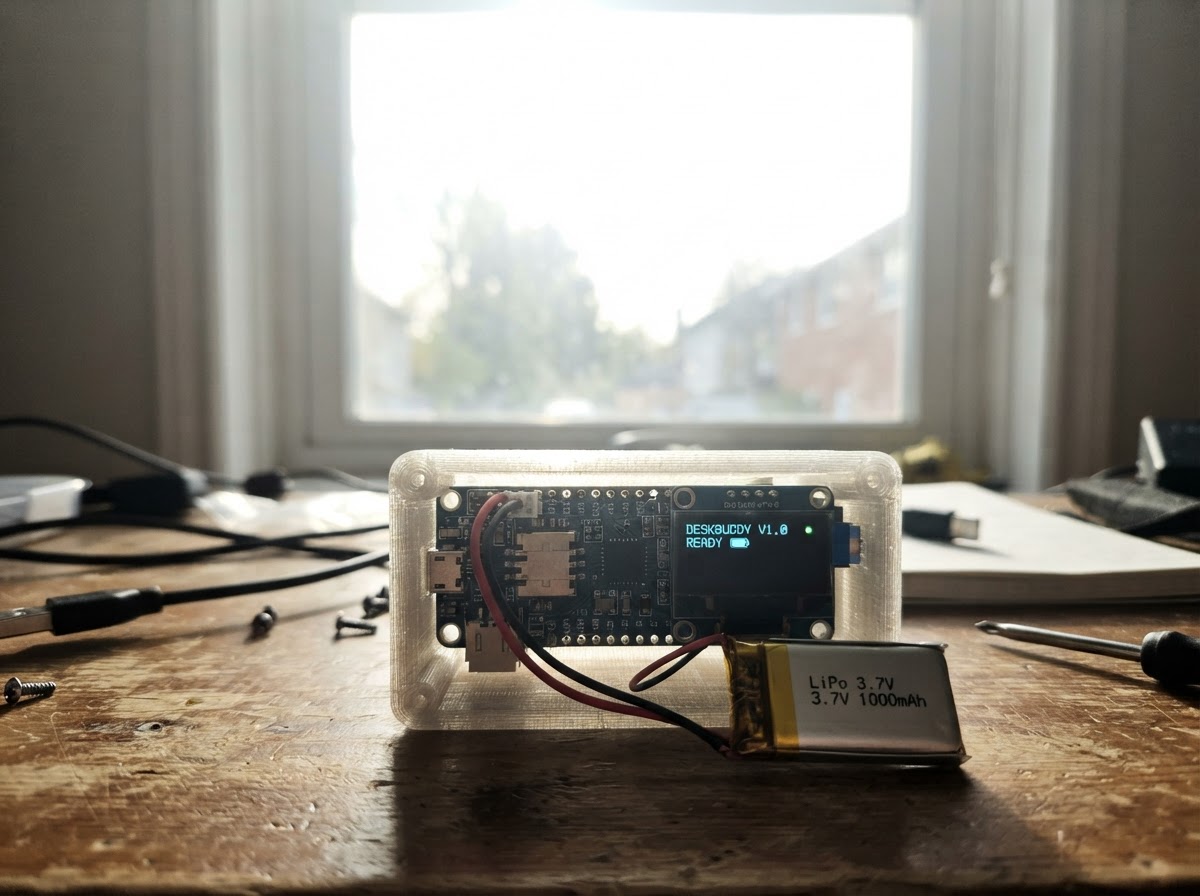
Tiny Touch DeskBuddy is a palm-sized animated companion that sits on your desk, displaying an expressive face, local weather, time, and moon phase on a 1.47-inch touchscreen. Built around the Waveshare ESP32-C6-Touch-LCD module and powered by a compact 1000mAh LiPo battery, it responds to touch interactions and tilts its eyes based on the device's orientation thanks to the built-in IMU sensor.
This guide provides a complete parts list, wiring diagram, and step-by-step assembly instructions for the 3D-printed enclosure. You'll also get the full Arduino firmware, which handles Wi-Fi connectivity for live weather data, touch gesture recognition, and animated rendering—everything needed to bring your DeskBuddy to life.
Wiring diagram

Gather all the parts
Assemble it in 4 steps
1. Prepare the printed enclosure
Use a rigid printed shell with a front opening for the 1.47-inch screen and a USB-C opening. Dry-fit the board before adding the battery. Provide at least 2 mm clearance behind the display, rounded edges wherever the pouch cell sits, and a small exit path for the battery lead.
- PETG is preferred if the enclosure may sit in a warm sunny room; PLA is suitable for a normal indoor desk.
- Use plastic standoffs, foam tape, or nonconductive pads so the board underside cannot short against screws or foil-backed tape.
- Do not make the battery compartment airtight or place the cell directly against sharp printed posts, screw tips, or hot components.
- Keep the USB-C port accessible; it is the board's charging input.
2. Mount the Waveshare board
Fit the Waveshare ESP32-C6-Touch-LCD-1.47 board with the display facing the front opening. Secure it without over-tightening or flexing the LCD, and confirm the touch surface and USB-C connector are unobstructed.
- All display, touch, and IMU connections are already built into the board; do not add jumper wires to its display pins.
- Before final closure, check that the screen is not under pressure from the bezel.
- Disconnect battery and USB power before changing any wiring.
3. Connect the protected single-cell LiPo
Solder or fit a polarized, keyed two-wire pigtail with strain relief: battery +V to the Waveshare VBAT header (H1 pin 2) and battery GND to a board GND header (for example H1 pin 4). Verify polarity with a multimeter before connecting the battery. Secure the protected 1S LiPo flat in its compartment with suitable foam tape.
- Use only a protected 1S LiPo/Li-ion pack: 3.6/3.7 V nominal and 4.2 V maximum.
- Leave a gentle service loop in the battery lead so opening the enclosure does not pull on the header.
- Never connect the raw LiPo to 3V3, VBUS, or the USB-C connector.
- The board's onboard charger is set near 2 A; use a pack explicitly rated to accept at least 2 A charge current, or do not use the onboard charging path.
- Never use a swollen, damaged, unprotected, 2S, 5 V, or LiFePO4 battery.
4. Close, configure Wi-Fi, and inspect
Arrange the battery lead away from the display edges and USB-C opening, then close the enclosure without pinching the pouch. Before deploying, add the local Wi-Fi name and password to include/secrets.h. Once connected, DeskBuddy automatically estimates its city from the network public IP and obtains weather for that area.
- IP-based location is typically city-level, not GPS-precise. VPNs, relays, and some ISPs may report a different city.
- After the first charge, inspect the enclosure for excess heat and confirm the cell remains cool and flat.
- Charge only through the board USB-C port from a normal 5 V USB supply.
- Stop using the device immediately if the battery swells, smells unusual, becomes hot, or the enclosure deforms.
Review all connections
1. Connections between "lipo-battery-1" and "ESP32"
Deploy the firmware
// ============================================================
// DeskBuddy — Waveshare ESP32-C6-Touch-LCD-1.47
// Features: animated face, clock, date, local weather, moon.
// Touch swipes change pages; face taps provide care; the built-in
// QMI8658 IMU makes the eyes drift with the enclosure's tilt.
// ============================================================
#include <Arduino.h>
#include <Arduino_GFX_Library.h>
#include <ArduinoJson.h>
#include <HTTPClient.h>
#include <WiFi.h>
#include <Wire.h>
#include <math.h>
#include <string.h>
#include "secrets.h"
// Wi-Fi and installed location live in include/secrets.h.
// Leaving WIFI_SSID blank keeps the weather page in setup mode.
// ── Pin definitions ────────────────────────────────────────
#define LCD_BL 23
#define LCD_DC 15
#define LCD_CS 14
#define LCD_SCK 1
#define LCD_MOSI 2
#define LCD_RST 22
#define TOUCH_SDA 18
#define TOUCH_SCL 19
#define TOUCH_RST 20
#define TOUCH_INT 21
struct AccelData {
float accelX;
float accelY;
float accelZ;
uint32_t timestamp;
};
struct GyroData {
float gyroX;
float gyroY;
float gyroZ;
uint32_t timestamp;
};
struct calData {
bool valid;
float accelBias[3];
float gyroBias[3];
};
struct TouchPoint {
uint16_t x;
uint16_t y;
};
struct touch_data_t {
uint8_t count;
TouchPoint coords[1]; // first active touch point used by this UI
};
// Forward declarations
void updateBuddyNeeds();
void resetSharedI2CBus();
void bsp_touch_init(TwoWire *wire, uint8_t rstPin, uint8_t intPin, uint8_t rotation, uint16_t dispW, uint16_t dispH);
void bsp_touch_read();
uint16_t clampTouchCoord(int32_t value, uint16_t maxValue);
uint16_t scaleTouchAxis(uint16_t raw, uint16_t rawMin, uint16_t rawMax, uint16_t outMax);
bool bsp_touch_get_coordinates(uint16_t *outX, uint16_t *outY);
uint16_t rgb(uint8_t r, uint8_t g, uint8_t b);
float clampFloat(float v, float lo, float hi);
void lcdRegInit();
uint32_t compileTimeSeconds();
uint8_t compileMonthNumber();
int32_t daysFromCivil(int32_t y, uint8_t mo, uint8_t d);
void civilFromDays(int32_t z, int32_t *year, uint8_t *month, uint8_t *day);
int32_t compileDateDays();
void centeredText(const char *text, int y, uint8_t size);
void drawPageDots();
void drawHeader(const char *title);
void switchApp(int8_t delta);
bool wifiConfigured();
bool ensureWifi();
bool fetchLocation();
void drawWeatherIcon(int cx, int cy, int code, bool isDay);
bool fetchWeather();
void drawEye(int cx, int cy, int w, int h, bool closed, int px, int py);
void drawMouth(int cx, int cy);
void drawFace(float tx, float ty);
void drawDigitSegment(int x, int y, int w, int h, int t, uint8_t seg);
void drawDigit(int x, int y, uint8_t digit);
void drawClock();
void drawDatePage();
void drawWeather();
void drawMoonDisc(int cx, int cy, int radius, float phase);
void drawMoon();
void triggerFaceTap();
void readSensors();
void readTouch();
void updateFaceTimers();
void updateAutoPage();
void updateNetworkPages();
void calibrateNeutral();
uint32_t lastI2CResetMs = 0;
void resetSharedI2CBus() {
uint32_t now = millis();
if (now - lastI2CResetMs < 250) return;
lastI2CResetMs = now;
Wire.end();
delay(5);
Wire.begin(TOUCH_SDA, TOUCH_SCL);
Wire.setClock(100000);
}
#define IMU_ADDRESS 0x6B
class QMI8658Mini {
public:
int init(calData cal, uint8_t address = IMU_ADDRESS) {
imuAddress = address;
calibration = cal;
if (read8(0x00) != 0x05) return -1; // WHO_AM_I
write8(0x60, 0xFF); // soft reset
delay(100);
write8(0x02, 0x40); // CTRL1: auto-increment
setAccelRange(4);
setGyroRange(512);
write8(0x06, 0x03); // CTRL5: accel/gyro low-pass defaults
write8(0x08, 0x03); // CTRL7: enable accel + gyro
delay(100);
return 0;
}
int setAccelRange(int range) {
uint8_t config = 0x10;
if (range == 2) { accelScale = 2.0f / 32768.0f; config = 0x00; }
else if (range == 4) { accelScale = 4.0f / 32768.0f; config = 0x10; }
else if (range == 8) { accelScale = 8.0f / 32768.0f; config = 0x20; }
else if (range == 16) { accelScale = 16.0f / 32768.0f; config = 0x30; }
else return -1;
write8(0x08, 0x00);
rmw8(0x03, 0x70, config); // CTRL2 accel range bits
write8(0x08, 0x03);
return 0;
}
int setGyroRange(int range) {
uint8_t config = 0x50;
if (range == 128 || range == 125) { gyroScale = 128.0f / 32768.0f; config = 0x30; }
else if (range == 256 || range == 250) { gyroScale = 256.0f / 32768.0f; config = 0x40; }
else if (range == 512 || range == 500) { gyroScale = 512.0f / 32768.0f; config = 0x50; }
else if (range == 1024 || range == 1000) { gyroScale = 1024.0f / 32768.0f; config = 0x60; }
else if (range == 2048 || range == 2000) { gyroScale = 2048.0f / 32768.0f; config = 0x70; }
else return -1;
write8(0x08, 0x00);
rmw8(0x04, 0x70, config); // CTRL3 gyro range bits
write8(0x08, 0x03);
return 0;
}
void update() {
uint8_t status = read8(0x2E); // STATUS0: accel/gyro ready bits
if ((status & 0x03) == 0) return;
uint8_t raw[12] = {0};
if (!readBytes(0x35, raw, sizeof(raw))) return;
int16_t ax = (int16_t)((raw[1] << 8) | raw[0]);
int16_t ay = (int16_t)((raw[3] << 8) | raw[2]);
int16_t az = (int16_t)((raw[5] << 8) | raw[4]);
int16_t gx = (int16_t)((raw[7] << 8) | raw[6]);
int16_t gy = (int16_t)((raw[9] << 8) | raw[8]);
int16_t gz = (int16_t)((raw[11] << 8) | raw[10]);
uint32_t now = micros();
accel.accelX = ax * accelScale - calibration.accelBias[0];
accel.accelY = ay * accelScale - calibration.accelBias[1];
accel.accelZ = az * accelScale - calibration.accelBias[2];
accel.timestamp = now;
gyro.gyroX = gx * gyroScale - calibration.gyroBias[0];
gyro.gyroY = gy * gyroScale - calibration.gyroBias[1];
gyro.gyroZ = gz * gyroScale - calibration.gyroBias[2];
gyro.timestamp = now;
}
void getAccel(AccelData *out) { *out = accel; }
void getGyro(GyroData *out) { *out = gyro; }
private:
uint8_t imuAddress = IMU_ADDRESS;
float accelScale = 4.0f / 32768.0f;
float gyroScale = 512.0f / 32768.0f;
calData calibration = {0};
AccelData accel = {0};
GyroData gyro = {0};
uint8_t read8(uint8_t reg) {
uint8_t value = 0;
readBytes(reg, &value, 1);
return value;
}
bool readBytes(uint8_t reg, uint8_t *buffer, uint8_t len) {
Wire.beginTransmission(imuAddress);
Wire.write(reg);
if (Wire.endTransmission(true) != 0) { resetSharedI2CBus(); return false; }
delayMicroseconds(300);
if (Wire.requestFrom((uint8_t)imuAddress, len, (uint8_t)true) != len) {
resetSharedI2CBus();
return false;
}
for (uint8_t i = 0; i < len; i++) buffer[i] = Wire.read();
return true;
}
void write8(uint8_t reg, uint8_t value) {
Wire.beginTransmission(imuAddress);
Wire.write(reg);
Wire.write(value);
Wire.endTransmission();
}
void rmw8(uint8_t reg, uint8_t mask, uint8_t value) {
uint8_t current = read8(reg);
write8(reg, (current & ~mask) | (value & mask));
}
};
// ── AXS5106L inline touch reader ──────────────────────────
// The AXS5106L is the capacitive touch controller on the
// Waveshare ESP32-C6-Touch-LCD-1.47. ESP-IDF components exist,
// but this Arduino starter inlines a small polling reader so it
// does not need the ESP-IDF/LVGL touch stack.
// Protocol: I2C @ 400 kHz, 7-bit device address 0x63.
// Touch packets are read from register 0x01. The packet starts
// with gesture_id, touch_count, then point data. This sketch uses
// the first active point for tap/swipe navigation.
#define AXS5106L_ADDR 0x63
#define AXS5106L_TOUCH_DATA_REG 0x01
static TwoWire *_touchWire = nullptr;
static uint8_t _touchRst = 255;
static uint8_t _touchInt = 255;
static uint16_t _touchW = 320;
static uint16_t _touchH = 172;
static uint8_t _touchRot = 0;
void bsp_touch_init(TwoWire *wire, uint8_t rstPin, uint8_t intPin,
uint8_t rotation, uint16_t dispW, uint16_t dispH) {
_touchWire = wire;
_touchRst = rstPin;
_touchInt = intPin;
_touchRot = rotation;
_touchW = dispW;
_touchH = dispH;
if (_touchRst != 255) {
pinMode(_touchRst, OUTPUT);
digitalWrite(_touchRst, LOW);
delay(20);
digitalWrite(_touchRst, HIGH);
delay(50);
}
if (_touchInt != 255) {
pinMode(_touchInt, INPUT_PULLUP);
}
}
// bsp_touch_read — no-op for polling mode; INT pin can be
// checked externally if needed.
void bsp_touch_read() {}
uint16_t clampTouchCoord(int32_t value, uint16_t maxValue) {
if (value < 0) return 0;
if (value >= maxValue) return maxValue - 1;
return (uint16_t)value;
}
uint16_t scaleTouchAxis(uint16_t raw, uint16_t rawMin, uint16_t rawMax, uint16_t outMax) {
if (rawMax <= rawMin || outMax == 0) return 0;
if (raw <= rawMin) return 0;
if (raw >= rawMax) return outMax - 1;
return (uint32_t)(raw - rawMin) * (outMax - 1) / (rawMax - rawMin);
}
// Returns true if at least one touch point is active.
bool bsp_touch_get_coordinates(uint16_t *outX, uint16_t *outY) {
if (!_touchWire || !outX || !outY) return false;
// Read only the first 6-byte touch frame. The UI only uses one point, and
// shorter reads are less flaky than asking this controller for the optional
// second-point bytes on every frame.
_touchWire->beginTransmission(AXS5106L_ADDR);
_touchWire->write(AXS5106L_TOUCH_DATA_REG);
if (_touchWire->endTransmission(true) != 0) { resetSharedI2CBus(); return false; }
delayMicroseconds(300);
uint8_t len = _touchWire->requestFrom((uint8_t)AXS5106L_ADDR, (uint8_t)6, (uint8_t)true);
if (len < 6) { resetSharedI2CBus(); return false; }
uint8_t buf[6];
for (uint8_t i = 0; i < 6; i++) buf[i] = _touchWire->read();
uint8_t nPoints = buf[1] & 0x0F;
if (nPoints == 0 || nPoints > 2) return false;
// First point begins at byte 2: x_hi/event, x_lo, y_hi/id, y_lo.
uint16_t rawX = ((uint16_t)(buf[2] & 0x0F) << 8) | buf[3];
uint16_t rawY = ((uint16_t)(buf[4] & 0x0F) << 8) | buf[5];
if ((rawX == 0x0FFF && rawY == 0x0FFF) || rawX > 4090 || rawY > 4090) return false;
// Small edge dead-zone compensation. The controller reports raw axes with a
// few pixels of slack at the extremes; scaling them to the active screen area
// makes edge swipes less sticky while preserving the current orientation.
const uint16_t edge = 3;
uint16_t mappedX = rawX;
uint16_t mappedY = rawY;
switch (_touchRot) {
case 1: // landscape, default for this board
mappedX = scaleTouchAxis(rawY, edge, _touchW > edge ? _touchW - 1 - edge : _touchW - 1, _touchW);
mappedY = scaleTouchAxis(rawX, edge, _touchH > edge ? _touchH - 1 - edge : _touchH - 1, _touchH);
break;
case 2:
mappedX = _touchW - 1 - scaleTouchAxis(rawX, edge, _touchW > edge ? _touchW - 1 - edge : _touchW - 1, _touchW);
mappedY = _touchH - 1 - scaleTouchAxis(rawY, edge, _touchH > edge ? _touchH - 1 - edge : _touchH - 1, _touchH);
break;
case 3:
mappedX = _touchW - 1 - scaleTouchAxis(rawY, edge, _touchW > edge ? _touchW - 1 - edge : _touchW - 1, _touchW);
mappedY = scaleTouchAxis(rawX, edge, _touchH > edge ? _touchH - 1 - edge : _touchH - 1, _touchH);
break;
default: // 0 — portrait
mappedX = scaleTouchAxis(rawX, edge, _touchW > edge ? _touchW - 1 - edge : _touchW - 1, _touchW);
mappedY = scaleTouchAxis(rawY, edge, _touchH > edge ? _touchH - 1 - edge : _touchH - 1, _touchH);
break;
}
*outX = clampTouchCoord(mappedX, _touchW);
*outY = clampTouchCoord(mappedY, _touchH);
return true;
}
// ── End AXS5106L driver ────────────────────────────────────
static const int SCREEN_W = 320;
static const int SCREEN_H = 172;
static const uint8_t APP_COUNT = 5;
static const uint32_t HUNGER_INTERVAL_MS = 45UL * 60UL * 1000UL;
static const uint32_t ATTENTION_DECAY_MS = 20UL * 60UL * 1000UL;
static const uint32_t PAGE_AUTO_INTERVAL_MS = 8000;
static const uint16_t FG = RGB565_WHITE;
static const uint16_t BG = RGB565_BLACK;
static const uint8_t ROTATION = 1;
Arduino_DataBus *bus = new Arduino_HWSPI(LCD_DC, LCD_CS, LCD_SCK, LCD_MOSI);
Arduino_GFX *display = new Arduino_ST7789(bus, LCD_RST, 0, false, 172, 320, 34, 0, 34, 0);
Arduino_Canvas *gfx = new Arduino_Canvas(SCREEN_W, SCREEN_H, display);
QMI8658Mini imu;
calData calib = {0};
AccelData accel;
GyroData gyro;
bool imuReady = false;
bool touchReady = false;
bool touchWasDown = false;
bool wifiAttempted = false;
bool weatherValid = false;
uint8_t currentApp = 0;
uint8_t faceMood = 0;
uint16_t touchStartX = 0;
uint16_t touchStartY = 0;
uint16_t touchLastX = 0;
uint16_t touchLastY = 0;
uint32_t touchStartMs = 0;
uint8_t touchMissFrames = 0;
bool touchMoved = false;
uint32_t nextBlink = 1400;
uint32_t blinkUntil = 0;
uint32_t nextGlance = 900;
uint32_t nextAutoPage = PAGE_AUTO_INTERVAL_MS;
uint32_t lastSerialMs = 0;
uint32_t clockStartMillis = 0;
uint32_t clockStartSeconds = 0;
uint32_t weatherUpdatedAt = 0;
uint32_t locationCheckedAt = 0;
uint32_t lastNeedsUpdateMs = 0;
float restAx = 0.0f;
float restAy = 0.0f;
float filteredAx = 0.0f;
float filteredAy = 0.0f;
float filteredGz = 0.0f;
float faceGlanceX = 0.0f;
float faceGlanceY = 0.0f;
float faceTargetX = 0.0f;
float faceTargetY = 0.0f;
float pressPulse = 0.0f;
int weatherTempF = 0;
int weatherHumidity = 0;
int weatherWindMph = 0;
int weatherCode = -1;
bool weatherIsDay = true;
bool locationValid = false;
float locationLat = 0.0f;
float locationLon = 0.0f;
String locationLabel = "LOCATING";
String weatherLabel = "WAITING";
float attentionLevel = 100.0f; // taps refill attention; it fades over time
float hungerLevel = 0.0f; // rises gradually after power-on
// ── Helpers ────────────────────────────────────────────────
uint16_t rgb(uint8_t r, uint8_t g, uint8_t b) {
return ((r & 0xF8) << 8) | ((g & 0xFC) << 3) | (b >> 3);
}
float clampFloat(float v, float lo, float hi) {
return v < lo ? lo : v > hi ? hi : v;
}
// ── LCD init sequence for the AXS15231B panel ─────────────
void lcdRegInit() {
static const uint8_t ops[] = {
BEGIN_WRITE,
WRITE_COMMAND_8, 0x11,
END_WRITE,
DELAY, 120,
BEGIN_WRITE,
WRITE_C8_D16, 0xDF, 0x98, 0x53,
WRITE_C8_D8, 0xB2, 0x23,
WRITE_COMMAND_8, 0xB7,
WRITE_BYTES, 4, 0x00, 0x47, 0x00, 0x6F,
WRITE_COMMAND_8, 0xBB,
WRITE_BYTES, 6, 0x1C, 0x1A, 0x55, 0x73, 0x63, 0xF0,
WRITE_C8_D16, 0xC0, 0x44, 0xA4,
WRITE_C8_D8, 0xC1, 0x16,
WRITE_COMMAND_8, 0xC3,
WRITE_BYTES, 8, 0x7D, 0x07, 0x14, 0x06, 0xCF, 0x71, 0x72, 0x77,
WRITE_COMMAND_8, 0xC4,
WRITE_BYTES, 12, 0x00, 0x00, 0xA0, 0x79, 0x0B, 0x0A, 0x16, 0x79, 0x0B, 0x0A, 0x16, 0x82,
WRITE_COMMAND_8, 0xC8,
WRITE_BYTES, 32,
0x3F, 0x32, 0x29, 0x29, 0x27, 0x2B, 0x27, 0x28, 0x28, 0x26, 0x25, 0x17, 0x12, 0x0D, 0x04, 0x00,
0x3F, 0x32, 0x29, 0x29, 0x27, 0x2B, 0x27, 0x28, 0x28, 0x26, 0x25, 0x17, 0x12, 0x0D, 0x04, 0x00,
WRITE_COMMAND_8, 0xD0,
WRITE_BYTES, 5, 0x04, 0x06, 0x6B, 0x0F, 0x00,
WRITE_C8_D16, 0xD7, 0x00, 0x30,
WRITE_C8_D8, 0xE6, 0x14,
WRITE_C8_D8, 0xDE, 0x01,
WRITE_COMMAND_8, 0xB7,
WRITE_BYTES, 5, 0x03, 0x13, 0xEF, 0x35, 0x35,
WRITE_COMMAND_8, 0xC1,
WRITE_BYTES, 3, 0x14, 0x15, 0xC0,
WRITE_C8_D16, 0xC2, 0x06, 0x3A,
WRITE_C8_D16, 0xC4, 0x72, 0x12,
WRITE_C8_D8, 0xBE, 0x00,
WRITE_C8_D8, 0xDE, 0x02,
WRITE_COMMAND_8, 0xE5,
WRITE_BYTES, 3, 0x00, 0x02, 0x00,
WRITE_COMMAND_8, 0xE5,
WRITE_BYTES, 3, 0x01, 0x02, 0x00,
WRITE_C8_D8, 0xDE, 0x00,
WRITE_C8_D8, 0x35, 0x00,
WRITE_C8_D8, 0x3A, 0x05,
WRITE_COMMAND_8, 0x2A,
WRITE_BYTES, 4, 0x00, 0x22, 0x00, 0xCD,
WRITE_COMMAND_8, 0x2B,
WRITE_BYTES, 4, 0x00, 0x00, 0x01, 0x3F,
WRITE_C8_D8, 0xDE, 0x02,
WRITE_COMMAND_8, 0xE5,
WRITE_BYTES, 3, 0x00, 0x02, 0x00,
WRITE_C8_D8, 0xDE, 0x00,
WRITE_C8_D8, 0x36, 0x00,
WRITE_COMMAND_8, 0x21,
END_WRITE,
DELAY, 10,
BEGIN_WRITE,
WRITE_COMMAND_8, 0x29,
END_WRITE};
bus->batchOperation(ops, sizeof(ops));
}
// ── Compile-time clock seed ────────────────────────────────
uint32_t compileTimeSeconds() {
const char *t = __TIME__;
uint8_t hh = (t[0]-'0')*10 + (t[1]-'0');
uint8_t mm = (t[3]-'0')*10 + (t[4]-'0');
uint8_t ss = (t[6]-'0')*10 + (t[7]-'0');
return (uint32_t)hh*3600UL + (uint32_t)mm*60UL + ss;
}
uint8_t compileMonthNumber() {
const char *m = __DATE__;
static const char names[] = "JanFebMarAprMayJunJulAugSepOctNovDec";
for (uint8_t i = 0; i < 12; i++)
if (strncmp(m, names+i*3, 3) == 0) return i+1;
return 1;
}
int32_t daysFromCivil(int32_t y, uint8_t mo, uint8_t d) {
y -= mo <= 2;
const int32_t era = (y >= 0 ? y : y-399)/400;
const uint32_t yoe = (uint32_t)(y - era*400);
const uint32_t doy = (153*(mo+(mo>2?-3:9))+2)/5 + d - 1;
const uint32_t doe = yoe*365 + yoe/4 - yoe/100 + doy;
return era*146097 + (int32_t)doe - 719468;
}
void civilFromDays(int32_t z, int32_t *year, uint8_t *month, uint8_t *day) {
z += 719468;
const int32_t era = (z >= 0 ? z : z-146096)/146097;
const uint32_t doe = (uint32_t)(z - era*146097);
const uint32_t yoe = (doe - doe/1460 + doe/36524 - doe/146096)/365;
int32_t y = (int32_t)yoe + era*400;
const uint32_t doy = doe - (365*yoe + yoe/4 - yoe/100);
const uint32_t mp = (5*doy+2)/153;
const uint32_t d = doy - (153*mp+2)/5 + 1;
const uint32_t mo = mp + (mp < 10 ? 3 : -9);
y += mo <= 2;
*year = y;
*month = (uint8_t)mo;
*day = (uint8_t)d;
}
int32_t compileDateDays() {
const char *d = __DATE__;
uint8_t day = (d[4]==' ' ? 0 : d[4]-'0')*10 + (d[5]-'0');
int32_t y = (int32_t)(d[7]-'0')*1000 + (int32_t)(d[8]-'0')*100 +
(int32_t)(d[9]-'0')*10 + (d[10]-'0');
return daysFromCivil(y, compileMonthNumber(), day);
}
// ── Drawing primitives ────────────────────────────────────
void centeredText(const char *text, int y, uint8_t size) {
gfx->setTextSize(size);
gfx->setTextColor(FG);
int width = (int)strlen(text)*6*size;
gfx->setCursor((SCREEN_W-width)/2, y);
gfx->print(text);
}
void drawPageDots() {
int startX = SCREEN_W/2 - ((APP_COUNT-1)*16)/2;
for (uint8_t i = 0; i < APP_COUNT; i++) {
if (i == currentApp)
gfx->fillCircle(startX+i*16, SCREEN_H-12, 3, FG);
else
gfx->drawCircle(startX+i*16, SCREEN_H-12, 2, rgb(90,90,90));
}
}
void drawHeader(const char *title) {
gfx->fillScreen(BG);
gfx->drawLine(0, 20, SCREEN_W, 20, FG);
gfx->setTextSize(1);
gfx->setTextColor(FG);
gfx->setCursor(8, 7);
gfx->print(title);
}
// ── App navigation ────────────────────────────────────────
void switchApp(int8_t delta) {
currentApp = (currentApp + APP_COUNT + delta) % APP_COUNT;
pressPulse = 1.0f;
nextAutoPage = millis() + PAGE_AUTO_INTERVAL_MS;
}
// ── Wi-Fi ─────────────────────────────────────────────────
bool wifiConfigured() { return strlen(WIFI_SSID) > 0 && strlen(WIFI_PASSWORD) > 0; }
bool ensureWifi() {
if (WiFi.status() == WL_CONNECTED) return true;
if (!wifiConfigured() || wifiAttempted) return false;
wifiAttempted = true;
WiFi.mode(WIFI_STA);
WiFi.begin(WIFI_SSID, WIFI_PASSWORD);
uint32_t start = millis();
while (WiFi.status() != WL_CONNECTED && millis()-start < 3500UL) delay(120);
return WiFi.status() == WL_CONNECTED;
}
// ── Approximate IP location + Open-Meteo weather ───────────
// The location service uses the Wi-Fi network's public IP address. This is
// city-level only, needs Internet access, and can be wrong behind a VPN.
bool fetchLocation() {
if (!ensureWifi()) return false;
locationCheckedAt = millis();
HTTPClient http;
http.setTimeout(6000);
if (!http.begin("http://ip-api.com/json/?fields=status,city,lat,lon")) return false;
if (http.GET() != HTTP_CODE_OK) { http.end(); return false; }
JsonDocument doc;
DeserializationError err = deserializeJson(doc, http.getString());
http.end();
if (err || String(doc["status"].as<const char *>() ?: "") != "success") return false;
locationLat = doc["lat"].as<float>();
locationLon = doc["lon"].as<float>();
const char *city = doc["city"] | "LOCAL AREA";
locationLabel = String(city);
locationValid = true;
return true;
}
// ── Weather fetch (Open-Meteo, detected location) ──────────
const char *weatherCodeText(int code) {
if (code == 0) return "CLEAR";
if (code == 1 || code == 2) return "PARTLY CLOUDY";
if (code == 3) return "CLOUDY";
if (code == 45 || code == 48) return "FOG";
if ((code>=51&&code<=67)||(code>=80&&code<=82)) return "RAIN";
if (code >= 71 && code <= 77) return "SNOW";
if (code >= 95) return "STORM";
return "WEATHER";
}
void drawWeatherIcon(int cx, int cy, int code, bool isDay) {
if (code == 0) {
gfx->drawCircle(cx, cy, 22, FG);
for (uint8_t i = 0; i < 8; i++) {
float a = i*0.7854f;
gfx->drawLine(cx+(int)(cos(a)*30), cy+(int)(sin(a)*30),
cx+(int)(cos(a)*40), cy+(int)(sin(a)*40), FG);
}
if (!isDay) gfx->fillCircle(cx+11, cy-8, 18, BG);
return;
}
gfx->fillCircle(cx-19, cy+5, 19, FG);
gfx->fillCircle(cx+2, cy-6, 25, FG);
gfx->fillCircle(cx+27, cy+8, 17, FG);
gfx->fillRoundRect(cx-42, cy+8, 87, 25, 12, FG);
if ((code>=51&&code<=67)||(code>=80&&code<=82)) {
for (int x=-25; x<=25; x+=17) {
gfx->drawLine(cx+x, cy+45, cx+x-8, cy+62, FG);
gfx->drawLine(cx+x+1, cy+45, cx+x-7, cy+62, FG);
}
} else if (code>=71 && code<=77) {
for (int x=-24; x<=24; x+=24) {
gfx->drawLine(cx+x-6, cy+53, cx+x+6, cy+53, FG);
gfx->drawLine(cx+x, cy+47, cx+x, cy+59, FG);
gfx->drawLine(cx+x-5, cy+48, cx+x+5, cy+58, FG);
gfx->drawLine(cx+x+5, cy+48, cx+x-5, cy+58, FG);
}
}
}
bool fetchWeather() {
if (!ensureWifi()) return false;
if (!locationValid && !fetchLocation()) return false;
HTTPClient http;
http.setTimeout(6000);
if (!http.begin(
String("http://api.open-meteo.com/v1/forecast?latitude=") + String(locationLat, 4) +
"&longitude=" + String(locationLon, 4) +
"¤t=temperature_2m,relative_humidity_2m,weather_code,wind_speed_10m,is_day"
"&temperature_unit=fahrenheit&wind_speed_unit=mph&timezone=auto"))
return false;
if (http.GET() != HTTP_CODE_OK) { http.end(); return false; }
JsonDocument doc;
DeserializationError err = deserializeJson(doc, http.getString());
http.end();
if (err) return false;
weatherTempF = (int)round(doc["current"]["temperature_2m"].as<float>());
weatherHumidity = doc["current"]["relative_humidity_2m"].as<int>();
weatherWindMph = (int)round(doc["current"]["wind_speed_10m"].as<float>());
weatherCode = doc["current"]["weather_code"].as<int>();
weatherIsDay = doc["current"]["is_day"].as<int>() != 0;
weatherLabel = weatherCodeText(weatherCode);
weatherUpdatedAt = millis();
weatherValid = true;
return true;
}
// ── Face rendering ────────────────────────────────────────
void drawEye(int cx, int cy, int w, int h, bool closed, int px, int py) {
if (closed) {
gfx->fillRoundRect(cx-w/2, cy-3, w, 6, 3, FG);
return;
}
gfx->fillRoundRect(cx-w/2, cy-h/2, w, h, h/2, FG);
gfx->fillRoundRect(cx-7+px, cy-9+py, 14, 18, 7, BG);
}
void drawMouth(int cx, int cy) {
if (faceMood == 2) {
gfx->fillEllipse(cx, cy+2, 15, 21, FG);
gfx->fillEllipse(cx, cy+2, 7, 11, BG);
} else if (faceMood == 3) {
gfx->fillRoundRect(cx-38, cy, 76, 6, 3, FG);
} else if (faceMood == 4) {
gfx->drawLine(cx-28, cy+8, cx+28, cy-8, FG);
gfx->drawLine(cx-28, cy+9, cx+28, cy-7, FG);
} else {
int radius = (faceMood == 1) ? 48 : 40;
gfx->fillArc(cx, cy-16, radius, radius-5, 34.0f, 146.0f, FG);
}
}
void drawFace(float tx, float ty) {
uint32_t now = millis();
drawHeader("FACE");
float breathe = sin(now*0.0021f)*0.03f + pressPulse*0.08f;
int dx = (int)(tx*14.0f + faceGlanceX);
int dy = (int)(ty*8.0f + faceGlanceY);
int eyeW = 44 + (int)(breathe*28.0f);
int eyeH = (faceMood==2) ? 45 : (faceMood==3) ? 16 : (62 + (int)(breathe*18.0f));
bool blink = now < blinkUntil;
for (int x=12; x<SCREEN_W-12; x+=18) {
gfx->drawLine(x, 31, x+8, 31, FG);
gfx->drawLine(x+4,144, x+12,144, FG);
}
drawEye(114+dx, 75+dy, eyeW, eyeH, blink||faceMood==3, dx/4, dy/5);
drawEye(206+dx, 75+dy, eyeW, eyeH, blink||faceMood==3||faceMood==4, dx/4, dy/5);
drawMouth(160+dx/4, 116+dy/4);
drawPageDots();
}
// ── 7-segment clock ───────────────────────────────────────
void drawDigitSegment(int x, int y, int w, int h, int t, uint8_t seg) {
int half = h/2, r = t/2;
switch (seg) {
case 0: gfx->fillRoundRect(x+t, y, w-2*t, t, r, FG); break;
case 1: gfx->fillRoundRect(x+w-t, y+t, t, half-t, r, FG); break;
case 2: gfx->fillRoundRect(x+w-t, y+half, t, half-t, r, FG); break;
case 3: gfx->fillRoundRect(x+t, y+h-t, w-2*t, t, r, FG); break;
case 4: gfx->fillRoundRect(x, y+half, t, half-t, r, FG); break;
case 5: gfx->fillRoundRect(x, y+t, t, half-t, r, FG); break;
case 6: gfx->fillRoundRect(x+t, y+half-t/2, w-2*t, t, r, FG); break;
}
}
void drawDigit(int x, int y, uint8_t digit) {
static const uint8_t masks[10] = {
0b00111111,0b00000110,0b01011011,0b01001111,0b01100110,
0b01101101,0b01111101,0b00000111,0b01111111,0b01101111};
for (uint8_t seg = 0; seg < 7; seg++)
if (masks[digit%10] & (1<<seg)) drawDigitSegment(x, y, 42, 76, 8, seg);
}
void drawClock() {
uint32_t elapsed = (millis()-clockStartMillis)/1000UL;
uint32_t sod = (clockStartSeconds+elapsed)%86400UL;
uint8_t hh = sod/3600UL, mm = (sod/60UL)%60UL, ss = sod%60UL;
drawHeader("TIME");
drawDigit(43, 46, hh/10);
drawDigit(93, 46, hh%10);
if ((ss%2)==0) {
gfx->fillRoundRect(141, 68, 8, 8, 4, FG);
gfx->fillRoundRect(141, 96, 8, 8, 4, FG);
}
drawDigit(159, 46, mm/10);
drawDigit(209, 46, mm%10);
gfx->setTextSize(2); gfx->setTextColor(FG);
gfx->setCursor(268, 101);
if (ss < 10) gfx->print("0");
gfx->print(ss);
drawPageDots();
}
// ── Date page ─────────────────────────────────────────────
void drawDatePage() {
static const char *wd[] = {"SUNDAY","MONDAY","TUESDAY","WEDNESDAY","THURSDAY","FRIDAY","SATURDAY"};
static const char *mon[] = {"JAN","FEB","MAR","APR","MAY","JUN","JUL","AUG","SEP","OCT","NOV","DEC"};
uint32_t elapsedSec = (millis()-clockStartMillis)/1000UL;
int32_t days = compileDateDays() + (int32_t)((clockStartSeconds+elapsedSec)/86400UL);
int32_t year; uint8_t month, day;
civilFromDays(days, &year, &month, &day);
uint8_t weekday = (uint8_t)((days+4)%7);
drawHeader("DATE");
centeredText(wd[weekday], 35, 3);
char line[24];
snprintf(line, sizeof(line), "%s %02u", mon[month-1], day);
centeredText(line, 82, 5);
snprintf(line, sizeof(line), "%ld", (long)year);
centeredText(line, 130, 2);
drawPageDots();
}
// ── Weather page ──────────────────────────────────────────
void drawWeather() {
drawHeader(locationValid ? locationLabel.c_str() : "WEATHER");
if (!wifiConfigured()) {
centeredText("NO WIFI CONFIG", 70, 2);
centeredText("EDIT CONFIG", 102, 1);
drawPageDots(); return;
}
if (WiFi.status() != WL_CONNECTED) {
centeredText("CONNECTING", 75, 2);
drawWeatherIcon(250, 82, 3, true);
drawPageDots(); return;
}
if (!locationValid) { centeredText("FINDING LOCATION", 76, 2); drawPageDots(); return; }
if (!weatherValid) { centeredText("UPDATING", 76, 2); drawPageDots(); return; }
drawWeatherIcon(241, 70, weatherCode, weatherIsDay);
gfx->setTextSize(7); gfx->setTextColor(FG);
gfx->setCursor(20, 60); gfx->print(weatherTempF);
gfx->setTextSize(3); gfx->print("F");
gfx->setTextSize(1);
gfx->setCursor(24, 136); gfx->print(weatherLabel);
gfx->setCursor(146, 136); gfx->print("H "); gfx->print(weatherHumidity); gfx->print("%");
gfx->setCursor(214, 136); gfx->print("W "); gfx->print(weatherWindMph); gfx->print("MPH");
drawPageDots();
}
// ── Moon phase page ───────────────────────────────────────
const char *moonPhaseLabel(float phase) {
if (phase<0.03f||phase>0.97f) return "NEW MOON";
if (phase<0.22f) return "WAXING CRESCENT";
if (phase<0.28f) return "FIRST QUARTER";
if (phase<0.47f) return "WAXING GIBBOUS";
if (phase<0.53f) return "FULL MOON";
if (phase<0.72f) return "WANING GIBBOUS";
if (phase<0.78f) return "LAST QUARTER";
return "WANING CRESCENT";
}
void drawMoonDisc(int cx, int cy, int radius, float phase) {
phase = phase - floor(phase);
gfx->drawCircle(cx, cy, radius+3, rgb(72,72,72));
gfx->fillCircle(cx, cy, radius, FG);
if (phase<0.03f||phase>0.97f) {
gfx->fillCircle(cx, cy, radius-2, BG);
gfx->drawCircle(cx, cy, radius, FG);
return;
}
if (phase>0.47f && phase<0.53f) return;
int shadowX = (phase < 0.5f)
? cx - (int)(4.0f*radius*phase)
: cx + (int)(2.0f*radius - 4.0f*radius*(phase-0.5f));
gfx->fillCircle(shadowX, cy, radius, BG);
gfx->drawCircle(cx, cy, radius, FG);
}
void drawMoon() {
const float syn = 29.53058867f;
uint32_t elapsed = (millis()-clockStartMillis)/1000UL;
float days = (float)compileDateDays() + ((float)compileTimeSeconds()+(float)elapsed)/86400.0f;
float age = fmod(days-10962.7597f, syn);
if (age < 0.0f) age += syn;
float phase = age/syn;
int illumination = (int)round((1.0f-cos(phase*6.2831853f))*50.0f);
drawHeader("MOON");
drawMoonDisc(232, 82, 45, phase);
gfx->setTextSize(2); gfx->setTextColor(FG);
gfx->setCursor(24, 58); gfx->print(moonPhaseLabel(phase));
gfx->setTextSize(1);
gfx->setCursor(26, 98); gfx->print("AGE "); gfx->print(age, 1); gfx->print(" DAYS");
gfx->setCursor(26, 118); gfx->print("LIGHT "); gfx->print(illumination); gfx->print("%");
drawPageDots();
}
// ── Interaction handlers ──────────────────────────────────
void triggerFaceTap() {
if (currentApp == 0) {
// A tap is care: DeskBuddy feels noticed and gets a small snack.
attentionLevel = 100.0f;
hungerLevel = clampFloat(hungerLevel - 28.0f, 0.0f, 100.0f);
pressPulse = 1.0f;
} else {
switchApp(1);
}
nextAutoPage = millis() + PAGE_AUTO_INTERVAL_MS;
}
void readSensors() {
if (!imuReady) {
// Animate eyes sinusoidally when IMU is absent
filteredAx = sin(millis()*0.0012f)*0.12f;
filteredAy = cos(millis()*0.0010f)*0.12f;
return;
}
imu.update();
imu.getAccel(&accel);
imu.getGyro(&gyro);
filteredAx = filteredAx*0.88f + accel.accelX*0.12f;
filteredAy = filteredAy*0.88f + accel.accelY*0.12f;
filteredGz = filteredGz*0.82f + gyro.gyroZ*0.18f;
// A quick movement is acknowledged, but care and weather determine the mood.
if (fabs(filteredGz) > 130.0f) pressPulse = 1.0f;
}
void readTouch() {
if (!touchReady) return;
if (!touchWasDown && TOUCH_INT != 255 && digitalRead(TOUCH_INT) != LOW) return;
uint16_t x = 0, y = 0;
bsp_touch_read();
if (bsp_touch_get_coordinates(&x, &y)) {
uint32_t now = millis();
touchLastX = x; touchLastY = y;
touchMissFrames = 0;
if (!touchWasDown) {
touchStartX = x; touchStartY = y; touchStartMs = now;
touchMoved = false;
touchWasDown = true;
return;
}
int16_t dx = (int16_t)x-(int16_t)touchStartX;
int16_t dy = (int16_t)y-(int16_t)touchStartY;
if (abs(dx) > 12 || abs(dy) > 12) touchMoved = true;
if (abs(dx) > 55 && abs(dx) > abs(dy)+18) {
switchApp(dx < 0 ? 1 : -1);
touchWasDown = false;
touchMissFrames = 0;
touchMoved = false;
}
} else if (touchWasDown) {
// The AXS5106L INT/read path can miss the odd frame. Require a few
// consecutive misses before treating it as release, otherwise taps/swipes
// get chopped up and feel flaky.
if (++touchMissFrames < 3) return;
uint32_t pressMs = millis() - touchStartMs;
int16_t dx = (int16_t)touchLastX-(int16_t)touchStartX;
int16_t dy = (int16_t)touchLastY-(int16_t)touchStartY;
if (pressMs >= 35 && pressMs <= 650 && !touchMoved && abs(dx) < 35 && abs(dy) < 35) {
triggerFaceTap();
}
touchWasDown = false;
touchMissFrames = 0;
touchMoved = false;
}
}
void updateBuddyNeeds() {
uint32_t now = millis();
if (lastNeedsUpdateMs == 0) { lastNeedsUpdateMs = now; return; }
uint32_t elapsed = now - lastNeedsUpdateMs;
lastNeedsUpdateMs = now;
hungerLevel = clampFloat(hungerLevel + 100.0f * elapsed / HUNGER_INTERVAL_MS, 0.0f, 100.0f);
attentionLevel = clampFloat(attentionLevel - 100.0f * elapsed / ATTENTION_DECAY_MS, 0.0f, 100.0f);
// Priority keeps the face understandable: urgent care needs override weather.
if (hungerLevel >= 75.0f) faceMood = 4; // hungry / unhappy
else if (attentionLevel <= 25.0f) faceMood = 3; // ignored / sleepy
else if (weatherValid && (weatherCode >= 51 || weatherCode == 45 || weatherCode == 48)) faceMood = 4;
else if (weatherValid && weatherCode <= 1) faceMood = 1; // sunny = cheerful
else faceMood = 0;
}
void updateFaceTimers() {
uint32_t now = millis();
if (now > nextBlink) {
blinkUntil = now + (random(0,6)==0 ? 220 : 105);
nextBlink = now + 1000 + random(0, 2600);
}
if (now > nextGlance) {
faceTargetX = (float)random(-8, 9);
faceTargetY = (float)random(-4, 5);
nextGlance = now + 650 + random(0, 1500);
}
faceGlanceX = faceGlanceX*0.84f + faceTargetX*0.16f;
faceGlanceY = faceGlanceY*0.84f + faceTargetY*0.16f;
pressPulse *= 0.86f;
}
void updateAutoPage() {
if (millis() > nextAutoPage) switchApp(1);
}
void updateNetworkPages() {
// Re-check the IP location occasionally for a moved DeskBuddy, then refresh
// weather. Weather still updates off-screen because it informs Buddy's mood.
if (!locationValid || millis() - locationCheckedAt > 6UL * 60UL * 60UL * 1000UL) {
if (fetchLocation()) weatherValid = false;
}
if (locationValid && (!weatherValid || millis() - weatherUpdatedAt > 15UL * 60UL * 1000UL)) fetchWeather();
}
void calibrateNeutral() {
gfx->fillScreen(BG);
centeredText("HOLD STILL", 76, 2);
gfx->flush();
delay(900);
for (uint8_t i = 0; i < 100; i++) { imu.update(); delay(5); }
float sumX=0.0f, sumY=0.0f;
for (uint8_t i = 0; i < 140; i++) {
imu.update(); imu.getAccel(&accel);
sumX += accel.accelX; sumY += accel.accelY;
delay(5);
}
restAx = sumX/140.0f; restAy = sumY/140.0f;
filteredAx = restAx; filteredAy = restAy;
}
// ── Arduino entry points ──────────────────────────────────
void setup() {
Serial.begin(115200);
delay(150);
Serial.println("ESP32-C6 DeskBuddy starting");
if (!gfx->begin(40000000)) Serial.println("Display init failed — check wiring");
lcdRegInit();
display->setRotation(ROTATION);
pinMode(LCD_BL, OUTPUT);
digitalWrite(LCD_BL, HIGH);
gfx->fillScreen(BG);
gfx->flush();
Wire.begin(TOUCH_SDA, TOUCH_SCL);
Wire.setClock(100000);
bsp_touch_init(&Wire, TOUCH_RST, TOUCH_INT, ROTATION, gfx->width(), gfx->height());
touchReady = true;
Serial.println("Touch controller initialised");
int err = imu.init(calib, IMU_ADDRESS);
if (err == 0) {
imuReady = (imu.setAccelRange(4)==0 && imu.setGyroRange(512)==0);
if (imuReady) calibrateNeutral();
}
if (!imuReady) Serial.println("IMU unavailable — using animated fallback motion");
randomSeed(micros());
clockStartMillis = millis();
clockStartSeconds = compileTimeSeconds();
nextBlink = millis() + 1200;
nextGlance = millis() + 600;
nextAutoPage = millis() + PAGE_AUTO_INTERVAL_MS;
lastNeedsUpdateMs = millis();
}
void loop() {
readSensors();
readTouch();
updateAutoPage();
updateNetworkPages();
updateBuddyNeeds();
updateFaceTimers();
float tx=0.0f, ty=0.0f;
if (imuReady) {
tx = clampFloat(-(filteredAy-restAy)*2.2f, -1.0f, 1.0f);
ty = clampFloat( (filteredAx-restAx)*2.2f, -1.0f, 1.0f);
} else {
tx = sin(millis()*0.0014f)*0.25f;
ty = cos(millis()*0.0011f)*0.16f;
}
switch (currentApp) {
case 0: drawFace(tx, ty); break;
case 1: drawClock(); break;
case 2: drawDatePage(); break;
case 3: drawWeather(); break;
default: drawMoon(); break;
}
gfx->flush();
if (millis()-lastSerialMs > 1200) {
lastSerialMs = millis();
Serial.print("app="); Serial.print(currentApp);
Serial.print(" mood="); Serial.println(faceMood);
}
delay(24);
}Remix this project
Make it yours in one click
Open a full copy of this project in your own Schematik workspace — diagram, code, parts, and assembly steps included. Swap the sensor, add features, or redesign the whole thing with AI. The author's original stays untouched.