Community project
Abbey Wood Elizabeth Line Times
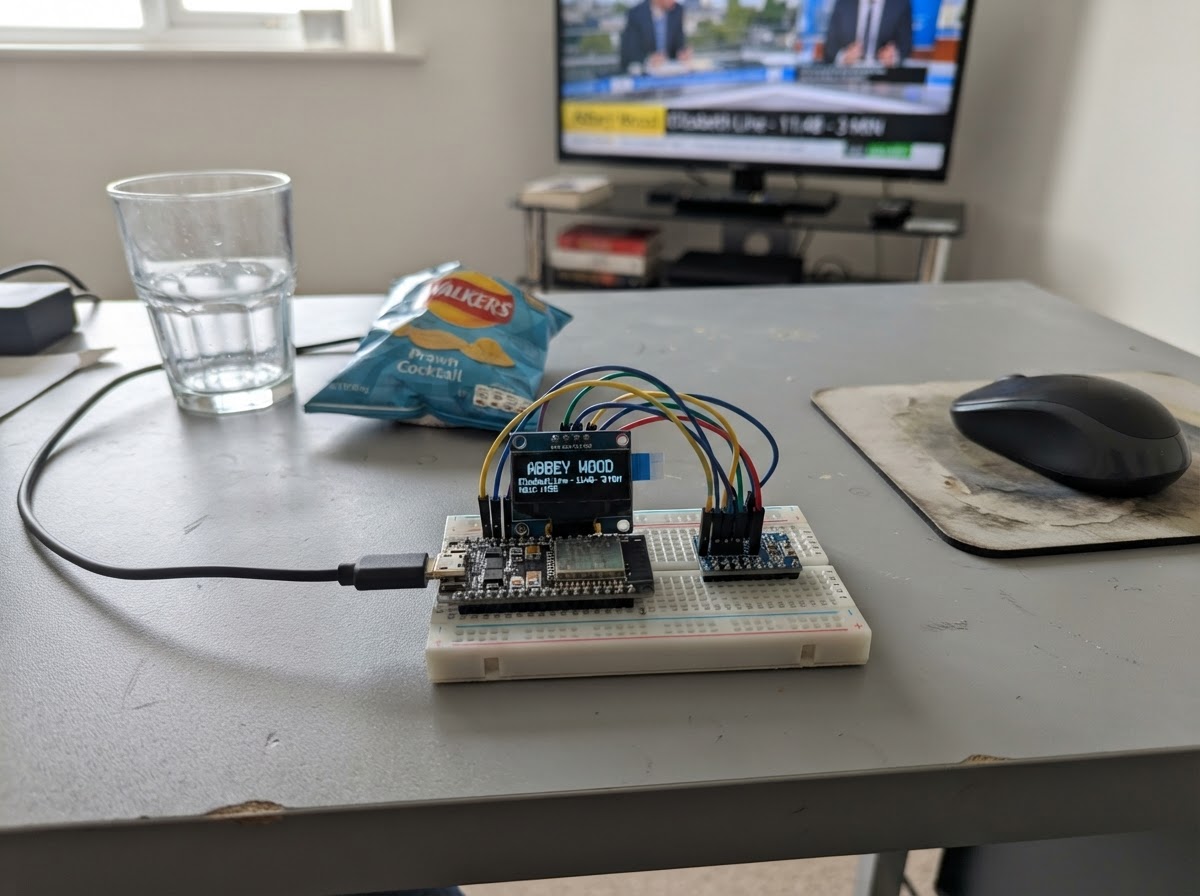
This project builds a real-time departure display for Abbey Wood station on London's Elizabeth Line. The ESP32 microcontroller fetches live train times from Transport for London's API and renders them on a 300x400 pixel display, updating every 60 seconds to show the next five departures.
The guide provides a complete parts list, wiring diagram for connecting the display to the ESP32, and step-by-step assembly instructions. Builders will configure Wi-Fi credentials, deploy the provided firmware, and mount the board where the display can be easily viewed. The result is a dedicated station information panel that works anywhere with internet access.
Wiring diagram
Assemble it in 4 steps
1. Place the board where the display can be lit
Set the Waveshare ESP32-S3-RLCD-4.2 on a stable surface with ambient light falling onto the front of the reflective LCD. This display has no backlight, so it needs room light or daylight to be readable.
- Avoid mounting the screen face-down or in a dark enclosed box.
- There are no external display wires to connect; the LCD is already wired inside the board.
- Do not expose the board or USB connector to rain, condensation, or conductive surfaces.
2. Connect USB-C power
Connect a suitable USB-C data-and-power cable from the board to your computer or a stable 5 V USB supply. The same cable powers the board and is used by Schematik’s Deploy button.
- Use a known-good data cable, not a charge-only cable.
- If your board has its optional 18650 holder fitted, leave the battery out for initial USB-powered testing.
- Never insert an 18650 cell with reversed polarity.
- Do not use a damaged, swollen, or unprotected lithium-ion cell.
3. Prepare the Wi-Fi placeholders
Before deployment, replace the WIFI_SSID and WIFI_PASSWORD placeholder text at the top of the firmware with your 2.4 GHz Wi-Fi network name and password. The screen will otherwise show its Wi-Fi setup message.
- Keep the quotation marks around each Wi-Fi value.
- The ESP32-S3 connects to 2.4 GHz Wi-Fi; a 5 GHz-only network will not work.
- Treat the project firmware as containing your Wi-Fi password after you add it.
4. Deploy and view departures
Use Schematik’s Deploy button. Once connected to Wi-Fi, the board requests TfL’s public Abbey Wood Elizabeth line arrivals data and displays the next five services. It refreshes every 60 seconds.
- Increase room lighting if the reflective screen appears faint.
- The TfL feed may temporarily show no services during disruption or outside service hours.
- This is an information display only; always check official TfL announcements before travelling.
Deploy the firmware
#include <Arduino.h>
#include <WiFi.h>
#include <WiFiClientSecure.h>
#include <HTTPClient.h>
#include <ArduinoJson.h>
#include <U8g2lib.h>
#include <SPI.h>
#include <time.h>

// Replace these placeholders before deployment. Keep the quotation marks.

// Hoisted type definitions
struct Departure {
  char destination[48];
  time_t expected;
};


// Forward declarations
bool credentialsMissing();
bool parseUtc(const char *isoTime, time_t &result);
void drawScreen();
void sortDepartures();
bool fetchDepartures();
void connectWifi();

const char *WIFI_SSID = "Speedy";
const char *WIFI_PASSWORD = "guillenDiniz1A";

constexpr char TFL_URL[] =
    "https://api.tfl.gov.uk/StopPoint/910GABWDXR/Arrivals?lineId=elizabeth";
constexpr uint32_t REFRESH_INTERVAL_MS = 60000;
constexpr int LCD_SCK = 11;
constexpr int LCD_MOSI = 12;
constexpr int LCD_CS = 40;
constexpr int LCD_DC = 5;
constexpr int LCD_RESET = 41;

// Physical panel is 300 x 400. Rotation R1 presents a 400 x 300 landscape dashboard.
U8G2_ST7305_300X400_F_4W_HW_SPI display(U8G2_R1, LCD_CS, LCD_DC, LCD_RESET);


Departure departures[5];
uint8_t departureCount = 0;
uint32_t lastRefresh = 0;
char statusMessage[56] = "Starting...";

bool credentialsMissing() {
  return strcmp(WIFI_SSID, "YOUR_WIFI_NAME") == 0 ||
         strcmp(WIFI_PASSWORD, "YOUR_WIFI_PASSWORD") == 0;
}

bool parseUtc(const char *isoTime, time_t &result) {
  int year, month, day, hour, minute, second;
  if (sscanf(isoTime, "%d-%d-%dT%d:%d:%d", &year, &month, &day, &hour,
             &minute, &second) != 6) return false;
  tm value = {};
  value.tm_year = year - 1900;
  value.tm_mon = month - 1;
  value.tm_mday = day;
  value.tm_hour = hour;
  value.tm_min = minute;
  value.tm_sec = second;
  result = mktime(&value); // setup() explicitly selects UTC.
  return result != static_cast<time_t>(-1);
}

void drawScreen() {
  display.clearBuffer();
  display.setFont(u8g2_font_helvB14_tf);
  display.drawStr(12, 24, "ELIZABETH LINE");
  display.setFont(u8g2_font_helvR10_tf);
  display.drawStr(12, 40, "Abbey Wood departures");
  display.drawHLine(12, 48, 376);

  if (credentialsMissing()) {
    display.setFont(u8g2_font_helvB12_tf);
    display.drawStr(12, 82, "Wi-Fi setup needed");
    display.setFont(u8g2_font_helvR10_tf);
    display.drawStr(12, 108, "Edit WIFI_SSID and WIFI_PASSWORD,");
    display.drawStr(12, 124, "then press Deploy again.");
  } else if (departureCount == 0) {
    display.setFont(u8g2_font_helvB12_tf);
    display.drawStr(12, 82, statusMessage);
    display.setFont(u8g2_font_helvR10_tf);
    display.drawStr(12, 106, "TfL data will retry automatically.");
  } else {
    time_t now = time(nullptr);
    for (uint8_t i = 0; i < departureCount; ++i) {
      int y = 75 + i * 40;
      long seconds = static_cast<long>(difftime(departures[i].expected, now));
      long minutes = seconds <= 30 ? 0 : (seconds + 30) / 60;
      char due[12];
      if (minutes == 0) strcpy(due, "Due");
      else snprintf(due, sizeof(due), "%ld min", minutes);
      display.setFont(u8g2_font_helvB12_tf);
      display.drawStr(12, y, departures[i].destination);
      display.setFont(u8g2_font_helvB10_tf);
      display.drawStr(386 - display.getStrWidth(due), y, due);
      display.drawHLine(12, y + 10, 376);
    }
  }

  display.setFont(u8g2_font_6x10_tf);
  display.drawStr(12, 289, statusMessage);
  // This driver transfers the complete monochrome buffer only after a visible update.
  display.sendBuffer();
}

void sortDepartures() {
  for (uint8_t i = 0; i + 1 < departureCount; ++i) {
    for (uint8_t j = i + 1; j < departureCount; ++j) {
      if (departures[j].expected < departures[i].expected) {
        Departure temporary = departures[i];
        departures[i] = departures[j];
        departures[j] = temporary;
      }
    }
  }
}

bool fetchDepartures() {
  WiFiClientSecure client;
  client.setInsecure(); // A CA bundle is not embedded; HTTPS is still encrypted.
  HTTPClient http;
  if (!http.begin(client, TFL_URL)) {
    strcpy(statusMessage, "Could not start TfL request");
    return false;
  }
  const int responseCode = http.GET();
  if (responseCode != HTTP_CODE_OK) {
    snprintf(statusMessage, sizeof(statusMessage), "TfL request error: %d", responseCode);
    http.end();
    return false;
  }

  DynamicJsonDocument doc(16384);
  const DeserializationError error = deserializeJson(doc, http.getStream());
  http.end();
  if (error) {
    strcpy(statusMessage, "Could not read TfL data");
    return false;
  }

  departureCount = 0;
  for (JsonObject item : doc.as<JsonArray>()) {
    if (departureCount == 5) break;
    const char *destination = item["destinationName"] | "Unknown destination";
    const char *expectedArrival = item["expectedArrival"] | "";
    time_t expected;
    if (!parseUtc(expectedArrival, expected)) continue;
    strncpy(departures[departureCount].destination, destination,
            sizeof(departures[departureCount].destination) - 1);
    departures[departureCount].destination[sizeof(departures[departureCount].destination) - 1] = '\0';
    departures[departureCount].expected = expected;
    ++departureCount;
  }

  sortDepartures();
  snprintf(statusMessage, sizeof(statusMessage), "Updated from TfL - %u services", departureCount);
  return departureCount > 0;
}

void connectWifi() {
  WiFi.mode(WIFI_STA);
  WiFi.begin(WIFI_SSID, WIFI_PASSWORD);
  const uint32_t started = millis();
  while (WiFi.status() != WL_CONNECTED && millis() - started < 15000) delay(250);
}

void setup() {
  Serial.begin(115200);
  setenv("TZ", "UTC0", 1);
  tzset();
  SPI.begin(LCD_SCK, -1, LCD_MOSI, LCD_CS);
  display.begin();

  if (credentialsMissing()) {
    strcpy(statusMessage, "Add Wi-Fi credentials in firmware");
    drawScreen();
    return;
  }

  connectWifi();
  if (WiFi.status() != WL_CONNECTED) {
    strcpy(statusMessage, "Wi-Fi connection failed");
    drawScreen();
    return;
  }

  configTime(0, 0, "pool.ntp.org", "time.nist.gov");
  const uint32_t started = millis();
  while (time(nullptr) < 1700000000 && millis() - started < 10000) delay(200);
  fetchDepartures();
  lastRefresh = millis();
  drawScreen();
}

void loop() {
  if (credentialsMissing()) return;
  if (WiFi.status() != WL_CONNECTED) connectWifi();

  if (millis() - lastRefresh >= REFRESH_INTERVAL_MS) {
    if (WiFi.status() == WL_CONNECTED) fetchDepartures();
    else strcpy(statusMessage, "Wi-Fi disconnected; retrying");
    lastRefresh = millis();
    drawScreen();
  }
}
Remix this project
Make it yours in one click
Open a full copy of this project in your own Schematik workspace — diagram, code, parts, and assembly steps included. Swap the sensor, add features, or redesign the whole thing with AI. The author's original stays untouched.
Related projects
Create A Complete Electrical Schematic Esp32 Sma
ESP32 · September 17, 2026Ayansh Agrawal
ESP32 Kare Ekran Projeleri
ESP32 · September 16, 2026Seref Ai
Component Qty --------------------------- ------
ESP32 · September 16, 2026Yathartha Chakrawal