Community project
Desk Voice Assistant
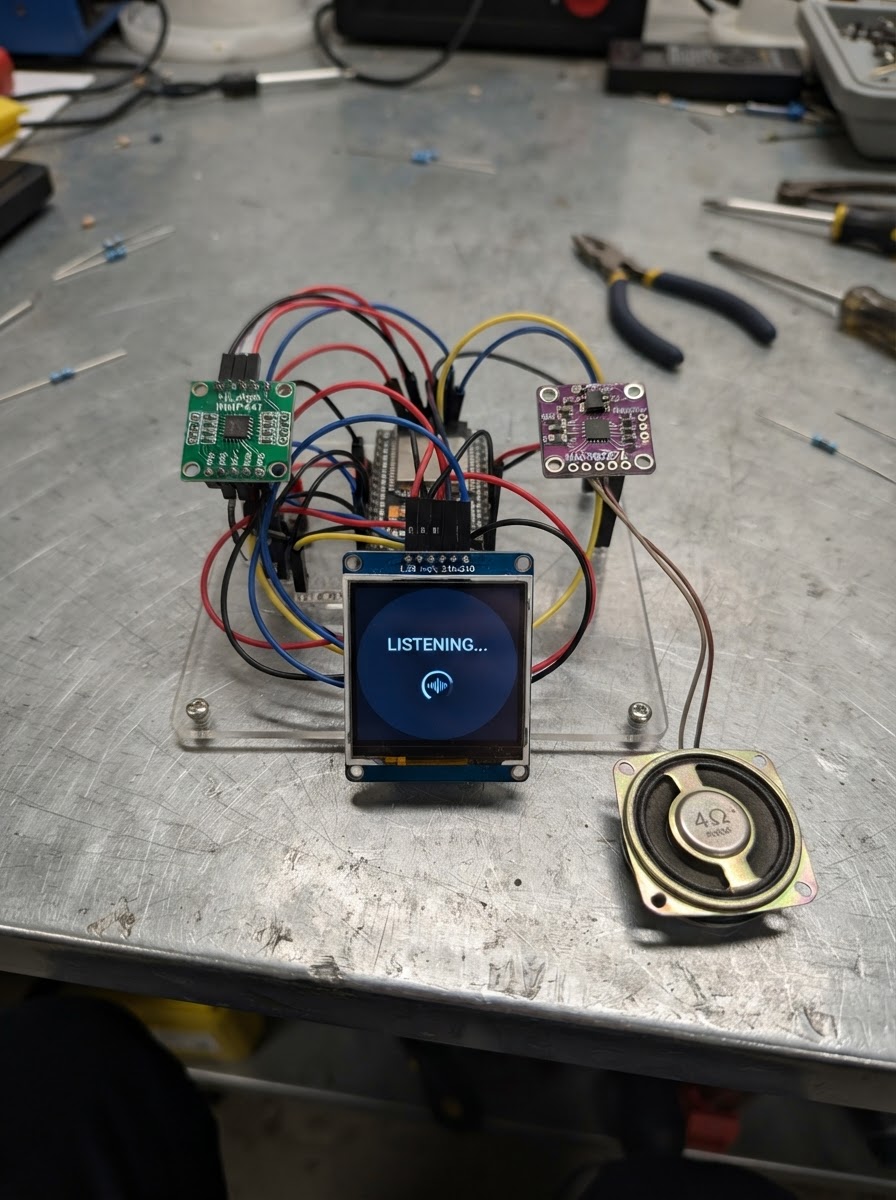
Build a compact desk voice assistant powered by an ESP32 that listens, thinks, and speaks back. Press a button to record audio through an I²S microphone, send it to OpenAI's Whisper for transcription, get a reply from GPT-4o-mini, and hear the response played through a speaker via a Class-D amplifier. A round 1.28-inch display shows the assistant's replies in real time.
This guide provides a complete wiring diagram, parts list, and ready-to-flash firmware that handles audio capture, Wi-Fi communication, API calls, and audio playback. Assembly takes about an hour and requires only a soldering iron and basic tools. Once deployed, configure your Wi-Fi credentials and OpenAI API key to bring your desk assistant to life.
Wiring diagram

Gather all the parts
Assemble it in 7 steps
1. Gather your parts
You need: ESP32-S3 DevKitC-1, INMP441 I2S microphone module, MAX98357A I2S amplifier breakout, 8Ω speaker, and GC9A01 240×240 round TFT display.
- The ESP32-S3 DevKitC-1 has two USB ports — use the one labelled UART/COM for deploying firmware via Schematik.
2. Wire the INMP441 microphone
Connect the INMP441 to the ESP32-S3: • VDD → 3.3V • GND → GND • SCK → GPIO1 • WS → GPIO2 • SD → GPIO3 • L/R → GND (selects left channel / mono)
- L/R tied to GND forces the mic into left-channel mode, which this firmware expects.
- Do not connect VDD to 5V — the INMP441 is a 3.3V part.
3. Wire the MAX98357A amplifier
Connect the MAX98357A to the ESP32-S3: • VIN → 5V (or 3.3V for lower volume) • GND → GND • BCLK → GPIO5 • LRC → GPIO6 • DIN → GPIO7 • SD (gain/shutdown) → GND (enables the amp at default gain)
- Powering VIN from 5V gives roughly double the output volume compared to 3.3V.
4. Connect the speaker
Connect the 8Ω speaker to the MAX98357A's SPK+ and SPK− screw terminals. Polarity is not critical for audio, but keep it consistent if using multiple speakers.
- Do NOT connect the speaker directly to any GPIO — always go through the MAX98357A amplifier.
5. Wire the GC9A01 round display
Connect the GC9A01 to the ESP32-S3: • VCC → 3.3V • GND → GND • SCK → GPIO12 • MOSI → GPIO11 • CS → GPIO10 • DC → GPIO14 • RST → GPIO21 • BL (backlight) → 3.3V (always on)
- The GC9A01 is 3.3V only — do not connect any pin to 5V.
- Double-check SCK and MOSI are not swapped — a common wiring mistake with SPI displays.
6. Power up via USB
Connect the ESP32-S3 DevKitC-1 to your computer using a USB-C cable plugged into the UART port. The board powers everything — mic, amp, and display all run from the board's 3.3V and 5V rails.
- If the USB-C cable only charges and doesn't show up as a serial port, try a different data-capable cable.
7. Deploy and configure
Before deploying, open main.cpp and fill in your Wi-Fi SSID, Wi-Fi password, and OpenAI API key in the three constants at the top of the file. Then press the Deploy button in Schematik. Once running, press the onboard BOOT button and speak — the display will animate through each state.
- The BOOT button is GPIO0 on the ESP32-S3 DevKitC-1 — it's the button labelled BOOT on the board edge.
- You can swap the TTS voice by changing 'nova' to alloy, echo, fable, onyx, or shimmer in the ttsSpeak() function.
Review all connections
1. Connections between "mic" and "ESP32"
2. Connections between "amp" and "ESP32"
3. Connections between "display" and "ESP32"
Deploy the firmware
/**
 * 🤖 AI Desk Assistant - ESP32-S3 DevKitC-1 + GC9A01 Round Display
 *
 * Flow:
 *   1. Press BOOT button → record 5 s from INMP441
 *   2. Whisper STT → transcript
 *   3. GPT-4o-mini → reply text (shown on display)
 *   4. OpenAI TTS → MP3 → MAX98357A speaker
 *
 * ── PIN MAP ──────────────────────────────────────────
 *  INMP441  SCK  → GPIO1    WS → GPIO2    SD → GPIO3
 *  MAX98357 BCLK → GPIO5   LRC → GPIO6   DIN → GPIO7
 *  GC9A01   SCK  → GPIO12  MOSI→ GPIO11  CS  → GPIO10
 *           DC   → GPIO14  RST → GPIO21  BL  → 3V3
 * ─────────────────────────────────────────────────────
 *
 * IMPORTANT: Set your Wi-Fi credentials and OpenAI API key below.
 */

#include <Arduino.h>
#include <WiFi.h>
#include <HTTPClient.h>
#include <WiFiClientSecure.h>
#include <ArduinoJson.h>
#include <driver/i2s.h>
#include <SPI.h>
#include <Adafruit_GFX.h>
#include <Adafruit_GC9A01A.h>

// ── USER CONFIG ───────────────────────────────────────

struct Message { String role; String content; };

enum State { S_IDLE, S_RECORDING, S_THINKING, S_SPEAKING };

const char* WIFI_SSID     = "YOUR_WIFI_SSID";
const char* WIFI_PASSWORD = "YOUR_WIFI_PASSWORD";
const char* OPENAI_KEY    = "sk-YOUR_OPENAI_API_KEY";
// ─────────────────────────────────────────────────────

// ── Pin definitions ───────────────────────────────────
#define MIC_SCK     1
#define MIC_WS      2
#define MIC_SD      3
#define AMP_BCLK    5
#define AMP_LRC     6
#define AMP_DIN     7

#define TFT_SCK    12
#define TFT_MOSI   11
#define TFT_CS     10
#define TFT_DC     14
#define TFT_RST    21

#define BUTTON_PIN 0   // Onboard BOOT button (active LOW)

// ── I2S ports ─────────────────────────────────────────
#define I2S_MIC_PORT  I2S_NUM_0
#define I2S_AMP_PORT  I2S_NUM_1

// ── Recording settings ────────────────────────────────
#define SAMPLE_RATE        16000
#define SAMPLE_BITS        16
#define RECORD_SECONDS     5
#define PCM_BUFFER_SIZE    (SAMPLE_RATE * (SAMPLE_BITS / 8) * RECORD_SECONDS)

// ── Playback settings ─────────────────────────────────
#define PLAYBACK_RATE     24000
#define MP3_BUFFER_SIZE   (128 * 1024)

// ── Conversation history ──────────────────────────────

static const int MAX_HISTORY = 8;
Message history[MAX_HISTORY];
int historyCount = 0;

// ── Audio buffers ─────────────────────────────────────
int16_t* pcmBuffer = nullptr;
uint8_t* mp3Buffer = nullptr;

// ── Display ───────────────────────────────────────────
Adafruit_GC9A01A tft(TFT_CS, TFT_DC, TFT_MOSI, TFT_SCK, TFT_RST);

// GC9A01 is 240×240; centre is (120,120), radius = 120
#define DISPLAY_W   240
#define DISPLAY_H   240
#define CX          120
#define CY          120

// 16-bit RGB565 colour helpers
#define COL_BG        0x0841   // Very dark navy
#define COL_RING      0x04FF   // Cyan ring
#define COL_RING_REC  0xF800   // Red ring when recording
#define COL_RING_THINK 0xFFE0  // Yellow ring when thinking
#define COL_RING_SPEAK 0x07E0  // Green ring when speaking
#define COL_TEXT      0xFFFF   // White
#define COL_SUBTEXT   0x7BEF   // Light grey
#define COL_FACE_BG   0x1082   // Dark blue-grey face

// ── State machine ─────────────────────────────────────

State curState = S_IDLE;

// ── Forward declarations ──────────────────────────────
void drawFace(State s, const String& label, const String& sub = "");
void animateRing(uint16_t colour, int frames);
void setupMicI2S();
void teardownMicI2S();
void setupAmpI2S();
void teardownAmpI2S();
bool recordAudio();
void writeWavHeader(uint8_t* buf, uint32_t pcmBytes, uint32_t sr, uint16_t ch, uint16_t bps);
String whisperTranscribe(int16_t* samples, size_t sampleCount);
String chatCompletion(const String& userMessage);
bool ttsSpeak(const String& text);
void playMP3(const uint8_t* data, size_t length);
void pushHistory(const String& role, const String& content);
void wrapText(const String& text, int maxChars, String& line1, String& line2);

// ─────────────────────────────────────────────────────
// ── Display helpers ───────────────────────────────────
// ─────────────────────────────────────────────────────

// Draw the full face for a given state
void drawFace(State s, const String& label, const String& sub) {
    // Background circle
    tft.fillCircle(CX, CY, 119, COL_FACE_BG);

    // Outer ring colour by state
    uint16_t ringCol = COL_RING;
    if (s == S_RECORDING) ringCol = COL_RING_REC;
    else if (s == S_THINKING) ringCol = COL_RING_THINK;
    else if (s == S_SPEAKING) ringCol = COL_RING_SPEAK;

    // Draw 4-pixel-wide ring
    for (int r = 119; r > 115; r--) {
        tft.drawCircle(CX, CY, r, ringCol);
    }

    // Robot eyes (two rounded rects)
    int eyeY = 85;
    int eyeW = 28, eyeH = 18, eyeR = 5;
    tft.fillRoundRect(CX - 40 - eyeW/2, eyeY, eyeW, eyeH, eyeR, COL_RING);
    tft.fillRoundRect(CX + 40 - eyeW/2, eyeY, eyeW, eyeH, eyeR, COL_RING);

    // Mouth bar (varies by state)
    int mouthY = 140;
    if (s == S_IDLE) {
        // Smile - simple arc approximated with lines
        for (int x = -28; x <= 28; x++) {
            int y = (x * x) / 60;
            tft.drawPixel(CX + x, mouthY + y, COL_RING);
            tft.drawPixel(CX + x, mouthY + y + 1, COL_RING);
        }
    } else if (s == S_RECORDING) {
        // Open O mouth
        tft.drawCircle(CX, mouthY + 8, 14, COL_RING_REC);
        tft.drawCircle(CX, mouthY + 8, 13, COL_RING_REC);
    } else if (s == S_THINKING) {
        // Flat thinking line
        tft.fillRoundRect(CX - 25, mouthY + 4, 50, 6, 3, COL_RING_THINK);
    } else if (s == S_SPEAKING) {
        // Sound wave bars
        int barW = 6, barGap = 4;
        int bars[] = {10, 20, 14, 22, 10};
        int totalW = 5 * barW + 4 * barGap;
        int startX = CX - totalW / 2;
        for (int b = 0; b < 5; b++) {
            int bh = bars[b];
            int bx = startX + b * (barW + barGap);
            tft.fillRoundRect(bx, mouthY + 10 - bh / 2, barW, bh, 2, COL_RING_SPEAK);
        }
    }

    // Label text (state name)
    tft.setTextColor(COL_TEXT);
    tft.setTextSize(2);
    int labelX = CX - (label.length() * 6);
    tft.setCursor(labelX, 175);
    tft.print(label);

    // Sub text (transcript / reply preview)
    if (sub.length() > 0) {
        String l1, l2;
        wrapText(sub, 18, l1, l2);
        tft.setTextColor(COL_SUBTEXT);
        tft.setTextSize(1);
        tft.setCursor(CX - l1.length() * 3, 198);
        tft.print(l1);
        if (l2.length() > 0) {
            tft.setCursor(CX - l2.length() * 3, 210);
            tft.print(l2);
        }
    }
}

// Wrap text to two lines of maxChars each
void wrapText(const String& text, int maxChars, String& line1, String& line2) {
    if ((int)text.length() <= maxChars) {
        line1 = text; line2 = "";
        return;
    }
    int split = text.lastIndexOf(' ', maxChars);
    if (split < 0) split = maxChars;
    line1 = text.substring(0, split);
    line2 = text.substring(split + 1);
    if ((int)line2.length() > maxChars) line2 = line2.substring(0, maxChars - 1) + "...";
}

// ─────────────────────────────────────────────────────
// ── Setup ─────────────────────────────────────────────
// ─────────────────────────────────────────────────────
void setup() {
    Serial.begin(115200);
    delay(800);

    pinMode(BUTTON_PIN, INPUT_PULLUP);

    // ── Init display ──
    tft.begin();
    tft.setRotation(0);
    tft.fillScreen(0x0000);
    drawFace(S_IDLE, "Booting", "Connecting...");

    // ── Allocate audio buffers ──
    pcmBuffer = (int16_t*)heap_caps_malloc(PCM_BUFFER_SIZE, MALLOC_CAP_DEFAULT);
    mp3Buffer = (uint8_t*)heap_caps_malloc(MP3_BUFFER_SIZE, MALLOC_CAP_DEFAULT);
    if (!pcmBuffer || !mp3Buffer) {
        tft.fillCircle(CX, CY, 119, 0xF800);
        tft.setCursor(60, CY - 8);
        tft.setTextColor(COL_TEXT); tft.setTextSize(2);
        tft.print("MEM ERR");
        while (true) delay(1000);
    }

    // ── Connect Wi-Fi ──
    Serial.printf("📶 Connecting to %s...\n", WIFI_SSID);
    WiFi.begin(WIFI_SSID, WIFI_PASSWORD);
    int attempts = 0;
    while (WiFi.status() != WL_CONNECTED && attempts < 40) {
        delay(500); Serial.print(".");
        attempts++;
    }
    if (WiFi.status() != WL_CONNECTED) {
        drawFace(S_IDLE, "No WiFi", "Check credentials");
        while (true) delay(1000);
    }
    Serial.printf("\n✅ IP: %s\n", WiFi.localIP().toString().c_str());

    // ── System prompt ──
    pushHistory("system",
        "You are a friendly, witty AI desk assistant. "
        "Keep replies concise - two or three sentences max. "
        "You are running on an ESP32-S3 DevKitC-1 microcontroller on someone's desk. "
        "Be helpful, a little playful, and never condescending.");

    drawFace(S_IDLE, "Ready!", "Hold BOOT to speak");
    Serial.println("🤖 Ready - press BOOT to speak!");
}

// ─────────────────────────────────────────────────────
// ── Main loop ─────────────────────────────────────────
// ─────────────────────────────────────────────────────
void loop() {
    if (digitalRead(BUTTON_PIN) == LOW) {
        delay(50);
        if (digitalRead(BUTTON_PIN) == LOW) {

            // ── RECORDING ──
            curState = S_RECORDING;
            drawFace(S_RECORDING, "Listening", "");
            Serial.println("\n🎙️  Recording...");

            setupMicI2S();
            bool gotAudio = recordAudio();
            teardownMicI2S();

            if (!gotAudio) {
                drawFace(S_IDLE, "Ready!", "Mic error-retry");
                return;
            }

            // ── THINKING: STT ──
            curState = S_THINKING;
            drawFace(S_THINKING, "Thinking", "Transcribing...");
            Serial.println("🧠 Whisper STT...");

            size_t sampleCount = PCM_BUFFER_SIZE / sizeof(int16_t);
            String transcript = whisperTranscribe(pcmBuffer, sampleCount);
            if (transcript.isEmpty()) {
                drawFace(S_IDLE, "Ready!", "Couldn't hear you");
                return;
            }
            Serial.printf("💬 You: %s\n", transcript.c_str());
            drawFace(S_THINKING, "Thinking", transcript);

            // ── THINKING: Chat ──
            Serial.println("💭 GPT...");
            String reply = chatCompletion(transcript);
            if (reply.isEmpty()) {
                drawFace(S_IDLE, "Ready!", "No reply");
                return;
            }
            Serial.printf("🤖 AI: %s\n", reply.c_str());

            // ── SPEAKING ──
            curState = S_SPEAKING;
            drawFace(S_SPEAKING, "Speaking", reply);
            Serial.println("🔊 Speaking...");

            setupAmpI2S();
            ttsSpeak(reply);
            teardownAmpI2S();

            // ── Back to idle ──
            curState = S_IDLE;
            drawFace(S_IDLE, "Ready!", "Hold BOOT to speak");

            while (digitalRead(BUTTON_PIN) == LOW) delay(10);
        }
    }
    delay(20);
}

// ─────────────────────────────────────────────────────
// ── I2S ───────────────────────────────────────────────
// ─────────────────────────────────────────────────────
void setupMicI2S() {
    i2s_config_t cfg = {
        .mode                 = (i2s_mode_t)(I2S_MODE_MASTER | I2S_MODE_RX),
        .sample_rate          = SAMPLE_RATE,
        .bits_per_sample      = I2S_BITS_PER_SAMPLE_32BIT,
        .channel_format       = I2S_CHANNEL_FMT_ONLY_LEFT,
        .communication_format = I2S_COMM_FORMAT_STAND_I2S,
        .intr_alloc_flags     = ESP_INTR_FLAG_LEVEL1,
        .dma_buf_count        = 8,
        .dma_buf_len          = 1024,
        .use_apll             = false,
        .tx_desc_auto_clear   = false,
        .fixed_mclk           = 0
    };
    i2s_pin_config_t pins = {
        .bck_io_num   = MIC_SCK,
        .ws_io_num    = MIC_WS,
        .data_out_num = I2S_PIN_NO_CHANGE,
        .data_in_num  = MIC_SD
    };
    i2s_driver_install(I2S_MIC_PORT, &cfg, 0, NULL);
    i2s_set_pin(I2S_MIC_PORT, &pins);
    i2s_zero_dma_buffer(I2S_MIC_PORT);
}

void teardownMicI2S() { i2s_driver_uninstall(I2S_MIC_PORT); }

void setupAmpI2S() {
    i2s_config_t cfg = {
        .mode                 = (i2s_mode_t)(I2S_MODE_MASTER | I2S_MODE_TX),
        .sample_rate          = PLAYBACK_RATE,
        .bits_per_sample      = I2S_BITS_PER_SAMPLE_16BIT,
        .channel_format       = I2S_CHANNEL_FMT_ONLY_LEFT,
        .communication_format = I2S_COMM_FORMAT_STAND_I2S,
        .intr_alloc_flags     = ESP_INTR_FLAG_LEVEL1,
        .dma_buf_count        = 8,
        .dma_buf_len          = 1024,
        .use_apll             = false,
        .tx_desc_auto_clear   = true,
        .fixed_mclk           = 0
    };
    i2s_pin_config_t pins = {
        .bck_io_num   = AMP_BCLK,
        .ws_io_num    = AMP_LRC,
        .data_out_num = AMP_DIN,
        .data_in_num  = I2S_PIN_NO_CHANGE
    };
    i2s_driver_install(I2S_AMP_PORT, &cfg, 0, NULL);
    i2s_set_pin(I2S_AMP_PORT, &pins);
    i2s_zero_dma_buffer(I2S_AMP_PORT);
}

void teardownAmpI2S() { i2s_driver_uninstall(I2S_AMP_PORT); }

// ─────────────────────────────────────────────────────
// ── Record audio ──────────────────────────────────────
// ─────────────────────────────────────────────────────
bool recordAudio() {
    size_t bytesRead = 0;
    size_t totalSamples = 0;
    const size_t maxSamples = PCM_BUFFER_SIZE / sizeof(int16_t);

    // Warm-up
    int32_t dummy[512];
    for (int w = 0; w < 5; w++) {
        i2s_read(I2S_MIC_PORT, dummy, sizeof(dummy), &bytesRead, portMAX_DELAY);
    }

    int32_t rawBuf[512];
    while (totalSamples < maxSamples) {
        i2s_read(I2S_MIC_PORT, rawBuf, sizeof(rawBuf), &bytesRead, portMAX_DELAY);
        size_t frames = bytesRead / sizeof(int32_t);
        for (size_t i = 0; i < frames && totalSamples < maxSamples; i++) {
            pcmBuffer[totalSamples++] = (int16_t)(rawBuf[i] >> 14);
        }
    }
    return totalSamples > 0;
}

// ─────────────────────────────────────────────────────
// ── WAV header ────────────────────────────────────────
// ─────────────────────────────────────────────────────
void writeWavHeader(uint8_t* buf, uint32_t pcmBytes, uint32_t sr, uint16_t ch, uint16_t bps) {
    uint32_t byteRate   = sr * ch * bps / 8;
    uint16_t blockAlign = ch * bps / 8;
    uint32_t riffSize   = 36 + pcmBytes;
    uint32_t fmtSize    = 16;
    uint16_t audioFmt   = 1;
    memcpy(buf,    "RIFF", 4); memcpy(buf+4,  &riffSize,   4);
    memcpy(buf+8,  "WAVE", 4); memcpy(buf+12, "fmt ",       4);
    memcpy(buf+16, &fmtSize,   4); memcpy(buf+20, &audioFmt,   2);
    memcpy(buf+22, &ch,        2); memcpy(buf+24, &sr,         4);
    memcpy(buf+28, &byteRate,  4); memcpy(buf+32, &blockAlign, 2);
    memcpy(buf+34, &bps,       2); memcpy(buf+36, "data",      4);
    memcpy(buf+40, &pcmBytes,  4);
}

// ─────────────────────────────────────────────────────
// ── Whisper STT ───────────────────────────────────────
// ─────────────────────────────────────────────────────
String whisperTranscribe(int16_t* samples, size_t sampleCount) {
    const int WAV_HEADER_SIZE = 44;
    uint32_t pcmBytes = sampleCount * sizeof(int16_t);
    uint8_t* wavBuf = mp3Buffer;
    if (pcmBytes + WAV_HEADER_SIZE > MP3_BUFFER_SIZE) { return ""; }

    writeWavHeader(wavBuf, pcmBytes, SAMPLE_RATE, 1, 16);
    memcpy(wavBuf + WAV_HEADER_SIZE, samples, pcmBytes);
    size_t wavSize = WAV_HEADER_SIZE + pcmBytes;

    WiFiClientSecure client; client.setInsecure();
    HTTPClient http;
    http.begin(client, "https://api.openai.com/v1/audio/transcriptions");
    http.addHeader("Authorization", String("Bearer ") + OPENAI_KEY);

    String boundary = "ESP32AI" + String(millis());
    http.addHeader("Content-Type", "multipart/form-data; boundary=" + boundary);

    String partHeader =
        "--" + boundary + "\r\n"
        "Content-Disposition: form-data; name=\"file\"; filename=\"audio.wav\"\r\n"
        "Content-Type: audio/wav\r\n\r\n";
    String modelPart =
        "\r\n--" + boundary + "\r\n"
        "Content-Disposition: form-data; name=\"model\"\r\n\r\n"
        "whisper-1\r\n"
        "--" + boundary + "--\r\n";

    size_t bodySize = partHeader.length() + wavSize + modelPart.length();
    uint8_t* bodyBuf = (uint8_t*)malloc(bodySize);
    if (!bodyBuf) { return ""; }

    memcpy(bodyBuf, partHeader.c_str(), partHeader.length());
    memcpy(bodyBuf + partHeader.length(), wavBuf, wavSize);
    memcpy(bodyBuf + partHeader.length() + wavSize, modelPart.c_str(), modelPart.length());

    int code = http.POST(bodyBuf, bodySize);
    free(bodyBuf);

    String transcript = "";
    if (code == 200) {
        JsonDocument doc;
        if (deserializeJson(doc, http.getString()) == DeserializationError::Ok) {
            transcript = doc["text"].as<String>();
            transcript.trim();
        }
    } else {
        Serial.printf("⚠️  Whisper %d\n", code);
    }
    http.end();
    return transcript;
}

// ─────────────────────────────────────────────────────
// ── Chat completion ───────────────────────────────────
// ─────────────────────────────────────────────────────
String chatCompletion(const String& userMessage) {
    pushHistory("user", userMessage);

    JsonDocument req;
    req["model"] = "gpt-4o-mini";
    JsonArray msgs = req["messages"].to<JsonArray>();
    for (int i = 0; i < historyCount; i++) {
        JsonObject m = msgs.add<JsonObject>();
        m["role"]    = history[i].role;
        m["content"] = history[i].content;
    }
    req["max_tokens"] = 150;
    String body; serializeJson(req, body);

    WiFiClientSecure client; client.setInsecure();
    HTTPClient http;
    http.begin(client, "https://api.openai.com/v1/chat/completions");
    http.addHeader("Authorization", String("Bearer ") + OPENAI_KEY);
    http.addHeader("Content-Type", "application/json");
    http.setTimeout(15000);

    int code = http.POST(body);
    String reply = "";
    if (code == 200) {
        JsonDocument doc;
        if (deserializeJson(doc, http.getString()) == DeserializationError::Ok) {
            reply = doc["choices"][0]["message"]["content"].as<String>();
            reply.trim();
            pushHistory("assistant", reply);
        }
    } else {
        Serial.printf("⚠️  Chat %d\n", code);
    }
    http.end();
    return reply;
}

// ─────────────────────────────────────────────────────
// ── TTS + playback ────────────────────────────────────
// ─────────────────────────────────────────────────────
bool ttsSpeak(const String& text) {
    JsonDocument req;
    req["model"]           = "tts-1";
    req["input"]           = text;
    req["voice"]           = "nova";
    req["response_format"] = "mp3";
    String body; serializeJson(req, body);

    WiFiClientSecure client; client.setInsecure();
    HTTPClient http;
    http.begin(client, "https://api.openai.com/v1/audio/speech");
    http.addHeader("Authorization", String("Bearer ") + OPENAI_KEY);
    http.addHeader("Content-Type", "application/json");
    http.setTimeout(15000);

    int code = http.POST(body);
    if (code == 200) {
        size_t mp3Len = http.getSize();
        if (mp3Len == 0 || mp3Len > MP3_BUFFER_SIZE) {
            http.end(); return false;
        }
        WiFiClient* stream = http.getStreamPtr();
        size_t received = 0;
        while (received < mp3Len && http.connected()) {
            int avail = stream->available();
            if (avail > 0) {
                int toRead = min((int)(MP3_BUFFER_SIZE - received), avail);
                received += stream->readBytes(mp3Buffer + received, toRead);
            }
            delay(1);
        }
        http.end();
        if (received > 0) { playMP3(mp3Buffer, received); return true; }
    } else {
        Serial.printf("⚠️  TTS %d\n", code);
        http.end();
    }
    return false;
}

// ─────────────────────────────────────────────────────
// ── MP3 decode + play ─────────────────────────────────
// ─────────────────────────────────────────────────────
#include "AudioTools.h"
#include "AudioCodecs/CodecMP3Helix.h"

void playMP3(const uint8_t* data, size_t length) {
    MemoryStream mp3Stream((uint8_t*)data, length);
    MP3DecoderHelix decoder;
    I2SStream i2sOut;
    I2SConfig i2sCfg = i2sOut.defaultConfig(TX_MODE);
    i2sCfg.port_no        = 1;
    i2sCfg.pin_bck        = AMP_BCLK;
    i2sCfg.pin_ws         = AMP_LRC;
    i2sCfg.pin_data       = AMP_DIN;
    i2sCfg.sample_rate    = PLAYBACK_RATE;
    i2sCfg.bits_per_sample = 16;
    i2sCfg.channels       = 1;
    i2sOut.begin(i2sCfg);
    EncodedAudioStream decoded(&i2sOut, &decoder);
    decoded.begin();
    StreamCopy copier(decoded, mp3Stream);
    while (mp3Stream.available()) copier.copy();
    decoded.end();
    i2sOut.end();
}

// ─────────────────────────────────────────────────────
// ── History management ────────────────────────────────
// ─────────────────────────────────────────────────────
void pushHistory(const String& role, const String& content) {
    if (historyCount < MAX_HISTORY) {
        history[historyCount++] = {role, content};
    } else {
        for (int i = 1; i < MAX_HISTORY - 1; i++) history[i] = history[i + 1];
        history[MAX_HISTORY - 1] = {role, content};
    }
}
Remix this project
Make it yours in one click
Open a full copy of this project in your own Schematik workspace — diagram, code, parts, and assembly steps included. Swap the sensor, add features, or redesign the whole thing with AI. The author's original stays untouched.