Community project
NFL Matchup Scoreboard
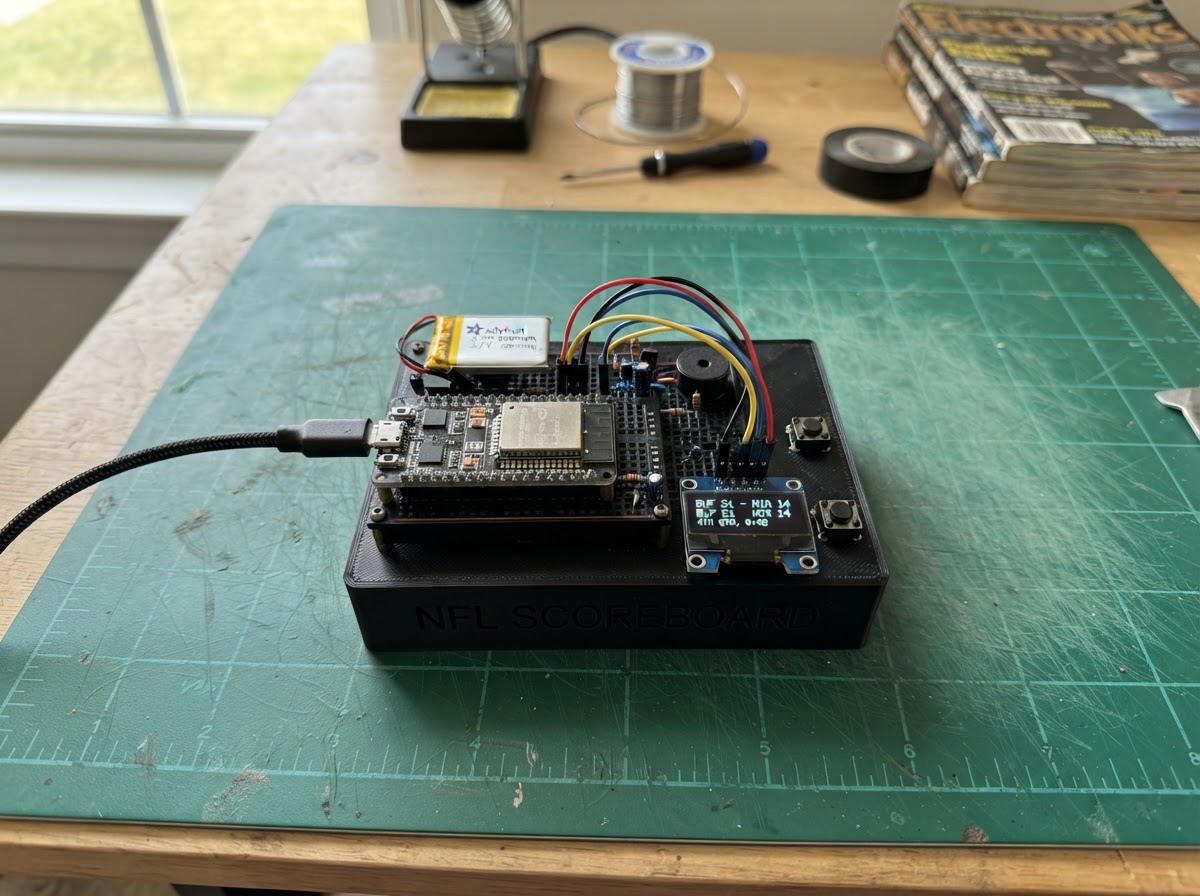
This NFL scoreboard displays live game matchups and scores on a bright 5-inch touchscreen powered by an ESP32-S3. The display automatically fetches current NFL game data from ESPN's API and cycles through each matchup, showing away and home teams with their scores and game status.
The guide includes a complete parts list, wiring diagram for the all-in-one smart display board, and ready-to-deploy firmware. Setup requires only connecting USB-C power and configuring WiFi credentials. Once running, the scoreboard refreshes scores every minute and rotates through active games every 8 seconds.
Wiring diagram
Assemble it in 4 steps
1. Use the all-in-one smart display board
Use a Sunton ESP32-S3-8048S050C N16R8 5-inch smart display board. The ESP32-S3, 800×480 landscape LCD, capacitive touch panel, display electronics, and USB-C connector are already built into one unit; do not add the former external 3.5-inch TFT or an ESP32 DevKit.
- The screen is normally used in its wide 800×480 landscape orientation.
- Touch is built in but is not needed for the automatic scoreboard rotation.
- Buy the N16R8 version: 16 MB flash and 8 MB PSRAM. Similar-looking boards can have a different screen or memory configuration.
2. Place the display safely
Put the board in a stand, frame, or enclosure that supports it by its mounting holes or edges. Keep the LCD face unobstructed and leave space around the back of the board for airflow.
- A slightly upward-facing angle makes weekend scores easier to read across a room.
- Do not press on the LCD surface or place conductive metal against the back of the powered board.
3. Connect only USB-C power
Connect a good-quality USB-C cable from a regulated 5 V USB power adapter or computer USB port to the board's USB-C connector. This one cable powers the ESP32-S3 and its built-in screen.
- Use a supply rated for at least 1 A to allow for display brightness and Wi-Fi activity.
- Use only normal 5 V USB power. Do not connect a 9 V or 12 V supply to the USB-C connector.
4. Deploy and position
Enter the Wi-Fi name and password in the firmware, then use Schematik's Deploy button. After deployment, put the display within range of that Wi-Fi network; it retrieves NFL scoreboard data over Wi-Fi and updates it automatically.
- The display shows a clear connection message until it joins Wi-Fi, then fetches the current scoreboard.
- No external sensor, display, or jumper wiring is required.
- The scoreboard needs an internet-connected Wi-Fi network to obtain live scores.
Deploy the firmware
#include <Arduino.h>
#include <WiFi.h>
#include <WiFiClientSecure.h>
#include <HTTPClient.h>
#include <ArduinoJson.h>
#include <Arduino_GFX_Library.h>

// Enter the Wi-Fi network used by this scoreboard before deploying.

// Hoisted type definitions
struct Game {
  String away;
  String home;
  String awayScore;
  String homeScore;
  String detail;
  String state;
};


// Forward declarations
uint16_t color(uint8_t r, uint8_t g, uint8_t b);
void centered(const String &text, int y, uint8_t size, uint16_t textColor);
void screenMessage(const String &message);
void drawGame(const Game &game);
bool loadScores();

constexpr char WIFI_SSID[] = "YOUR_WIFI_NAME";
constexpr char WIFI_PASSWORD[] = "YOUR_WIFI_PASSWORD";
constexpr char SCOREBOARD_URL[] =
    "https://site.api.espn.com/apis/site/v2/sports/football/nfl/scoreboard";

constexpr uint32_t SCORE_REFRESH_MS = 60000UL;
constexpr uint32_t PAGE_HOLD_MS = 8000UL;
constexpr int MAX_GAMES = 18;
constexpr int SCREEN_W = 800;
constexpr int SCREEN_H = 480;

// Factory-wired RGB interface of the Sunton ESP32-S3-8048S050C panel.
Arduino_DataBus *bus = new Arduino_ESP32RGBPanel(
    45, 48, 47, 21,
    4, 3, 2, 1, 0,
    10, 9, 8, 7, 6, 5,
    15, 14, 13, 12, 11,
    1, 10, 8, 50,
    1, 10, 8, 20);
Arduino_RGB_Display *gfx = new Arduino_RGB_Display(SCREEN_W, SCREEN_H, bus, 0, true);


Game games[MAX_GAMES];
int gameCount = 0;
int currentGame = 0;
bool dataAvailable = false;
uint32_t lastFetch = 0;
uint32_t pageStarted = 0;

uint16_t color(uint8_t r, uint8_t g, uint8_t b) {
  return gfx->color565(r, g, b);
}

void centered(const String &text, int y, uint8_t size, uint16_t textColor) {
  gfx->setTextSize(size);
  gfx->setTextColor(textColor);
  int16_t x1, y1;
  uint16_t width, height;
  gfx->getTextBounds(text, 0, y, &x1, &y1, &width, &height);
  gfx->setCursor((SCREEN_W - width) / 2, y);
  gfx->print(text);
}

void screenMessage(const String &message) {
  const uint16_t navy = color(0, 32, 91);
  gfx->fillScreen(BLACK);
  gfx->fillRect(0, 0, SCREEN_W, 72, navy);
  centered("NFL WEEKEND SCOREBOARD", 22, 3, WHITE);
  centered(message, 220, 2, color(205, 216, 232));
}

void drawGame(const Game &game) {
  const uint16_t navy = color(0, 32, 91);
  const uint16_t panel = color(12, 24, 45);
  const uint16_t outline = color(0, 95, 175);
  const uint16_t light = color(228, 236, 248);
  const uint16_t muted = color(151, 171, 200);
  const uint16_t live = color(239, 70, 63);
  const uint16_t scheduled = color(100, 200, 125);

  gfx->fillScreen(BLACK);
  gfx->fillRect(0, 0, SCREEN_W, 66, navy);
  centered("NFL WEEKEND SCOREBOARD", 18, 3, WHITE);

  gfx->fillRoundRect(28, 92, 744, 286, 18, panel);
  gfx->drawRoundRect(28, 92, 744, 286, 18, outline);

  gfx->setTextColor(muted);
  gfx->setTextSize(2);
  gfx->setCursor(70, 117);
  gfx->print("AWAY");
  gfx->setCursor(70, 255);
  gfx->print("HOME");

  gfx->setTextColor(light);
  gfx->setTextSize(6);
  gfx->setCursor(70, 148);
  gfx->print(game.away);
  gfx->setCursor(70, 286);
  gfx->print(game.home);

  gfx->setTextColor(WHITE);
  gfx->setTextSize(10);
  gfx->setCursor(610, 130);
  gfx->print(game.awayScore);
  gfx->setCursor(610, 268);
  gfx->print(game.homeScore);

  gfx->drawFastHLine(70, 239, 660, color(53, 76, 112));
  centered("AT", 215, 2, muted);
  centered(game.detail, 404, 2, game.state == "in" ? live : scheduled);

  gfx->fillRect(0, 452, SCREEN_W, 28, navy);
  centered(String(currentGame + 1) + " / " + String(gameCount) +
               "     Live scores refresh every 60 seconds",
           459, 1, light);
}

bool loadScores() {
  if (WiFi.status() != WL_CONNECTED) return false;

  WiFiClientSecure client;
  client.setInsecure();  // ESPN's public HTTPS endpoint; certificate is not stored in firmware.
  HTTPClient http;
  http.setTimeout(12000);
  if (!http.begin(client, SCOREBOARD_URL)) return false;

  const int status = http.GET();
  if (status != HTTP_CODE_OK) {
    http.end();
    return false;
  }

  JsonDocument doc;
  const DeserializationError error = deserializeJson(doc, http.getStream());
  http.end();
  if (error) return false;

  int newCount = 0;
  for (JsonObject event : doc["events"].as<JsonArray>()) {
    if (newCount >= MAX_GAMES) break;
    JsonObject competition = event["competitions"][0];
    if (competition.isNull()) continue;

    Game item;
    for (JsonObject competitor : competition["competitors"].as<JsonArray>()) {
      const String abbreviation = competitor["team"]["abbreviation"] | "TBD";
      const String score = competitor["score"] | "0";
      if (competitor["home"] | false) {
        item.home = abbreviation;
        item.homeScore = score;
      } else {
        item.away = abbreviation;
        item.awayScore = score;
      }
    }
    JsonObject statusType = competition["status"]["type"];
    item.detail = statusType["shortDetail"] | "Scheduled";
    item.state = statusType["state"] | "pre";
    games[newCount++] = item;
  }

  if (newCount == 0) return false;
  gameCount = newCount;
  currentGame %= gameCount;
  dataAvailable = true;
  return true;
}

void setup() {
  gfx->begin();
  if (String(WIFI_SSID).startsWith("YOUR_")) {
    screenMessage("Set Wi-Fi name and password in the firmware");
    return;
  }
  WiFi.mode(WIFI_STA);
  WiFi.begin(WIFI_SSID, WIFI_PASSWORD);
  screenMessage("Connecting to Wi-Fi...");
}

void loop() {
  const uint32_t now = millis();
  if (String(WIFI_SSID).startsWith("YOUR_")) return;

  if (WiFi.status() != WL_CONNECTED) {
    if (now - lastFetch >= 15000UL) {
      WiFi.reconnect();
      lastFetch = now;
    }
    return;
  }

  if (lastFetch == 0 || now - lastFetch >= SCORE_REFRESH_MS) {
    lastFetch = now;
    if (loadScores()) {
      pageStarted = now;
      drawGame(games[currentGame]);
    } else if (!dataAvailable) {
      screenMessage("Score service unavailable; retrying...");
    }
  }

  if (dataAvailable && now - pageStarted >= PAGE_HOLD_MS) {
    pageStarted = now;
    currentGame = (currentGame + 1) % gameCount;
    drawGame(games[currentGame]);
  }
}
Remix this project
Make it yours in one click
Open a full copy of this project in your own Schematik workspace — diagram, code, parts, and assembly steps included. Swap the sensor, add features, or redesign the whole thing with AI. The author's original stays untouched.
Related projects
Create A Complete Electrical Schematic Esp32 Sma
ESP32 · September 17, 2026Ayansh Agrawal
ESP32 Kare Ekran Projeleri
ESP32 · September 16, 2026Seref Ai
Component Qty --------------------------- ------
ESP32 · September 16, 2026Yathartha Chakrawal