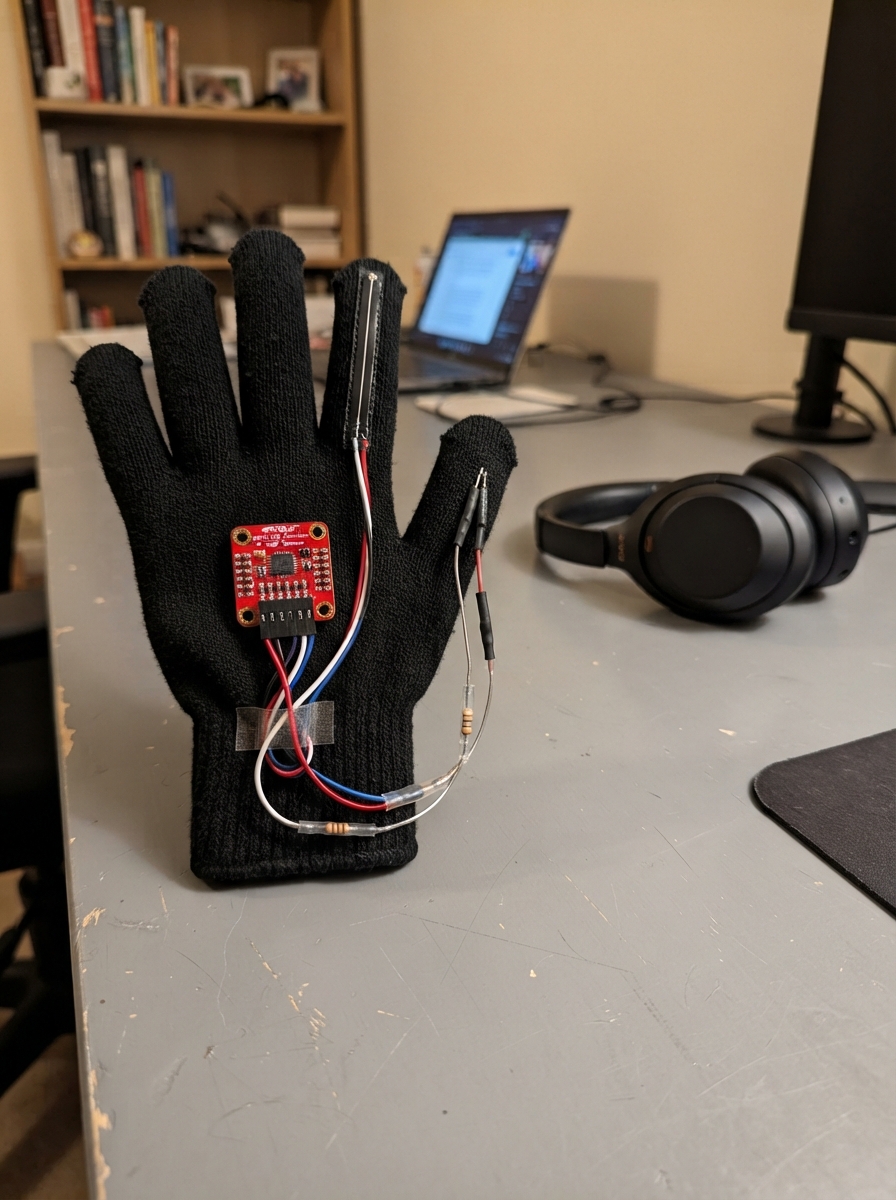
This project builds a wearable glove that recognizes hand gestures and sign language movements using flex sensors on each finger and motion tracking. The ESP32 microcontroller reads bend data from five flex sensors and acceleration data from an MPU-6050 IMU to classify hand poses in real time.
The guide provides a complete parts list, wiring diagrams for connecting each flex sensor and the motion sensor to the ESP32, and step-by-step assembly instructions for fitting the sensors to a glove. Firmware is included to train custom gestures, store them in device memory, and recognize repeated signs with stability detection.
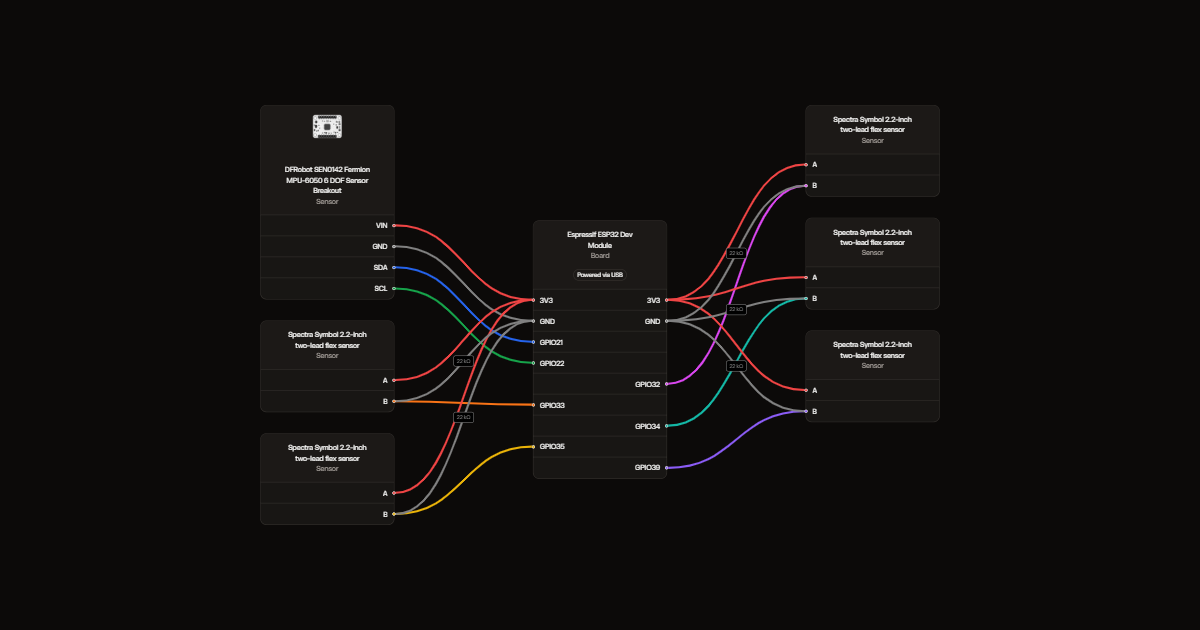
Wiring diagram
Gather all the parts
Assemble it in 7 steps
1. Wire the thumb sensor
With USB unplugged, connect either flex lead to 3V3. Connect the other lead and one resistor lead together at GPIO32. Connect the remaining resistor lead to GND.
2. Wire the index sensor
With USB unplugged, connect either flex lead to 3V3. Connect the other lead and one resistor lead together at GPIO33. Connect the remaining resistor lead to GND.
3. Wire the middle sensor
With USB unplugged, connect either flex lead to 3V3. Connect the other lead and one resistor lead together at GPIO34. Connect the remaining resistor lead to GND.
4. Wire the ring sensor
With USB unplugged, connect either flex lead to 3V3. Connect the other lead and one resistor lead together at GPIO35. Connect the remaining resistor lead to GND.
5. Wire the little sensor
With USB unplugged, connect either flex lead to 3V3. Connect the other lead and one resistor lead together at GPIO39. Connect the remaining resistor lead to GND.
6. Wire the motion sensor
Connect VIN to 3V3, GND to GND, SDA to GPIO21 for data, and SCL to GPIO22 for timing. Leave INT disconnected.
7. Fit the sensors to the glove
Slide each sensor into a loose fabric sleeve along the back of its finger. Secure the wire ends so they cannot pull on the sensor tabs. Fix the motion board flat to the back of your hand and insulate exposed contacts.
- Do not crease the sensors or bend their connector tabs.
Review all connections
1. Connections between "imu" and "ESP32"
2. Connections between "thumb" and "ESP32"
3. Connections between "r_thumb" and "ESP32"
4. Connections between "index" and "ESP32"
5. Connections between "r_index" and "ESP32"
6. Connections between "middle" and "ESP32"
7. Connections between "r_middle" and "ESP32"
8. Connections between "ring" and "ESP32"
9. Connections between "r_ring" and "ESP32"
10. Connections between "little" and "ESP32"
11. Connections between "r_little" and "ESP32"
Deploy the firmware
#include <Arduino.h>
#include <Wire.h>
#include <Preferences.h>
#include <math.h>

constexpr uint8_t pins[] = {32,33,34,35,39};
constexpr unsigned slots = 6, dims = 8;
struct Gesture { char label[24]; float v[dims]; };
Gesture bank[slots]{};
Preferences store;
bool saved = false;
uint8_t imu = 0;
unsigned count = 0;
int teaching = -1, pending = -1, emitted = -1;
unsigned stable = 0;
float sum[dims]{};
char label[24], line[64];
unsigned len = 0;
bool overflow = false;

bool readRegs(uint8_t address, uint8_t reg, uint8_t* data, uint8_t size) {
  Wire.beginTransmission(address); Wire.write(reg);
  if (Wire.endTransmission(false) || Wire.requestFrom(address,size) != size) return false;
  for (unsigned i=0;i<size;++i) data[i]=Wire.read();
  return true;
}
bool startImu() {
  for (uint8_t addr : {0x68,0x69}) {
    uint8_t id;
    if (!readRegs(addr,0x75,&id,1) || id != 0x68) continue;
    Wire.beginTransmission(addr); Wire.write(0x6B); Wire.write(0x01);
    if (!Wire.endTransmission()) { imu=addr; return true; }
  }
  return false;
}
int16_t word(const uint8_t* b) { return int16_t((uint16_t(b[0])<<8)|b[1]); }
// Return 0 on communication failure, 1 while moving, 2 for a steady pose.
int sample(float* v) {
  uint8_t b[14];
  if (!readRegs(imu,0x3B,b,14)) return 0;
  float norm=0;
  for(unsigned i=0;i<3;++i) {
    if(abs(int(word(b+8+2*i))) > 5200) return 1;
    v[5+i]=word(b+2*i)/16384.0f; norm+=v[5+i]*v[5+i];
  }
  if(norm<0.65f || norm>1.45f) return 1;
  for(unsigned i=0;i<5;++i) {
    unsigned raw=0; for(unsigned j=0;j<8;++j) raw+=analogRead(pins[i]);
    v[i]=raw/(8.0f*4095);
  }
  return 2;
}
void help() {
  Serial.println("Commands: teach 1 LABEL (slots 1-6), list, clear, help. Send with newline.");
  Serial.println("Teach while holding the pose; stay still until Saved. Move out of a pose before repeating it.");
}
void persist() {
  if (!saved || store.putBytes("poses",bank,sizeof bank)!=sizeof bank)
    Serial.println("Storage unavailable; change applies until reset only.");
}
void command() {
  if (!strcmp(line,"clear")) {
    memset(bank,0,sizeof bank); teaching=-1; pending=emitted=-1; stable=0;
    persist(); Serial.println("All poses cleared.");
  } else if (!strcmp(line,"list")) {
    for(unsigned i=0;i<slots;++i) Serial.printf("%u: %s\n",i+1,bank[i].label[0]?bank[i].label:"(empty)");
  } else if (!strncmp(line,"teach ",6) && line[6]>='1' && line[6]<='6' && line[7]==' ' && line[8] && strlen(line+8)<sizeof label) {
    teaching=line[6]-'1'; strcpy(label,line+8); count=0; memset(sum,0,sizeof sum);
    Serial.println("Hold still to capture...");
  } else help();
}
void setup() {
  Serial.begin(115200);
  Wire.begin(21,22,100000);
  analogReadResolution(12);
  saved=store.begin("glove",false);
  if(saved && store.getBytesLength("poses")==sizeof bank) store.getBytes("poses",bank,sizeof bank);
  help();
}
void loop() {
  while(Serial.available()) {
    char c=Serial.read();
    if(c=='\n') {
      line[len]=0;
      if(overflow) Serial.println("Command too long."); else if(len) command();
      len=0; overflow=false;
    } else if(c!='\r') {
      if(len<sizeof line-1) line[len++]=c; else overflow=true;
    }
  }
  static uint32_t tick=0;
  if(millis()-tick<25) return;
  tick=millis();
  if(!imu) {
    static uint32_t retry=0;
    if(tick<retry) return;
    retry=tick+1000;
    if(!startImu()) Serial.println("MPU6050 not found; check power, SDA and SCL.");
    return;
  }
  float v[dims]; int state=sample(v);
  if(!state) imu=0;
  if(teaching>=0) {
    if(state!=2) { count=0; memset(sum,0,sizeof sum); return; }
    for(unsigned i=0;i<dims;++i) sum[i]+=v[i];
    if(++count>=24) {
      auto& g=bank[teaching]; strcpy(g.label,label);
      for(unsigned i=0;i<dims;++i) g.v[i]=sum[i]/count;
      teaching=-1; pending=emitted=-1; stable=0;
      Serial.printf("Saved pose: %s\n",g.label); persist();
    }
    return;
  }
  int best=-1; float first=1e9f, second=1e9f;
  if(state==2) for(unsigned s=0;s<slots;++s) if(bank[s].label[0]) {
    float d=0;
    for(unsigned i=0;i<dims;++i) {
      float delta=(v[i]-bank[s].v[i])*(i<5?1.0f:0.25f); d+=delta*delta;
    }
    if(d<first) {second=first; first=d; best=s;} else if(d<second) second=d;
  }
  if(first>0.012f || second-first<0.0025f) best=-1;
  if(best!=pending) {pending=best; stable=0;}
  if(stable<12 && ++stable==12 && emitted!=pending) {
    emitted=pending;
    if(emitted>=0) Serial.printf("Recognized: %s\n",bank[emitted].label);
  }
}
Remix this project
Make it yours in one click
Open a full copy of this project in your own Schematik workspace, diagram, code, parts, and assembly steps included. Swap the sensor, add features, or redesign the whole thing with AI. The author's original stays untouched.